



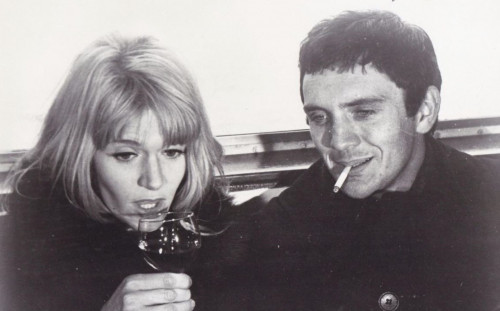
(1969) Police general Pierre Dux (later head of the Comédie Française)
lectures sunglassed-indoors cohorts on ideological mildew — “isms”
— now “infecting” society; then, as Mikis Theodorakis’ music throbs,
Dux’s helmeted and truncheoned police studiously look elsewhere as
a raging, chanting mob fills the city square awaiting the emergence
of charismatic deputy Yves Montand from his SRO ban-the-bomb
address — but what are those two punks doing careening in on that
three-wheeled kamikaze? “Just an accident” exhales legal honcho
François Périer as he leaves it to tinted-eyeglassed magistrate Jean-Louis Trintignant (Best Actor, Cannes) to wrap things up nicely. But
the crowds are painting big white Z’s in the street... Too much of a hot
potato for French producers, Greek expat Costa-Gavras’s adaptation
of Vassili Vassilikos’s novel of the real-life Lambrakis case was
skillfully filmed on a shoestring in Algeria (doubling for Greece), and
utilizing a pulsating score pieced together from previous Theodorakis
works (with the composer’s blessing: he was under house arrest in
Greece) and an incredible cast including Renato Salvatori (Rocco
and his Brothers) and Marcel Bozzuffi
(soon to be the shot-in-the-back poster
boy for The French Connection) as the
two punks; and the iconic Irene Papas,
the only actual Greek in the cast, who’s
told “He’s gone” by New Wave camera
legend Raoul Coutard, cameoing in a
break from his breakneck documentary-style
shooting. All of which, combined
with Costa-Gavras’ bullet-quick editing,
gave Z an immediacy, authenticity, and
excitement, that, along with perfect
timing — premiering so soon after the
right-wing colonels’ takeover in Greece
— made it a worldwide smash and the
winner of both the Cannes Jury Prize
(awarded unanimously) and the Best
Foreign Film Oscar (it was the official
entry from Algeria). Approx. 127 minutes
A RIALTO PICTURES RELEASE