




|
|
|
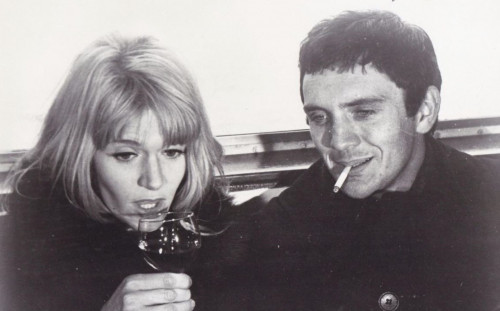
(1962) As that vital 2000 francs
proves elusive, and an ill-placed foot
gets her in trouble with les flics,
record store clerk and would-be
actress Anna Karina slides almost
inevitably onto the game. An old and
simple story, too often descending
into the maudlin — but not here, as
Godard’s detached, objective
treatment, while also a “passionate
celluloid love-letter” to his thenwife/
muse, brings a Brechtian
quality to an almost case study of
prostitution, while attaining its own
kind of pathos. From the initial
breakup, shot solely from behind
the participants in a bar; to the tearstained
viewing of Dreyer’s Passion
of Joan of Arc; to the equally tearstained
interview with a cop; to the
awkward, painful encounter with
that first customer; to the voiceover
of FAQs while a montage of day-today
routine unreels; Godard’s
elliptical style finds beauty in the
banal via the pearly grays of the
great Raoul Coutard’s camerawork.
With some typically eccentric asides:
the by-hand height measurement
(metrically-converted, Karina is 5'61/2");
a test on how to tell a lady from a
tramp; a drive past an endless
queue to see Jules and Jim;
Karina’s café discussion with an
elderly man (distinguished real-life
philosopher Brice Parain) that ranges from Dumas to Plato
to le mot juste to German philosophy; and the legendary
exuberant dance around the trying-to-concentrate billiards
player. “The camera by its discipline discourages us from
interpreting Nana’s life in a melodramatic way. . . Curious,
then, how moving Anna Karina makes Nana. She waits, she
drinks, she smokes, she walks the
streets, she makes some money,
she turns herself over to the first
pimp she meets, she gives up
control of her life... The effect is
astonishing. It is clear, astringent,
unsentimental, abrupt. Then it is
over. It was her life to live.” – Roger
Ebert. “Starts out as a documentary
on prostitution, ending as a
Monogram B movie . . . [Its] true
subject [is] the enigmatic beauty
and troubling presence of Karina,
and the mystery of Godard’s own
passionate involvement with her.”
– Tom Milne, Time Out (London). “Even its colder, more existentialist
moments are possessed of
considerable emotion. There’s
a passion there that’s hard to
define except in terms of
superb, totally fluid and,
for the time, completely
original and audacious
filmmaking... Only Godard
could have made this.”
– Derek Malcolm,
The Guardian (London). “Godard’s most
classically tragic film
[and] one that has had the
greatest practical influence
on the subsequent history
of cinema.” – Richard
Brody. “The best films
open doors, they support our impression that
cinema begins and begins again with them. Vivre
Sa Vie is one of those films.” – François Truffaut. Approx. 85 min.
A JANUS FILMS RELEASE.
1:00, 2:45, 4:30, 6:15, 8:00, 9:45
|