















|
“A fascinating depiction of a shimmering Hollywood genre-perhaps the greatest of them all!
No city could have been better suited to the genre, as the glitter and glamour of the city that never slept made the perfect complement to Hollywood sheen,
complete with big stars, big set pieces, and the most ornate apartments you'll ever see.”
– Zach Wigon, The L Magazine. Click here to read entire review
“Film Forum's delightful gift to the city!”
– NY Daily News
“The 39 comedies—screwball, black, musical, and otherwise—in Film Forum's MADCAP MANHATTAN series span the Jimmy Walker through the Ed Koch administrations. This retrospective is balm, a much-needed alternative to the bloated Oscar bait and other white elephants of December.”
– Melissa Anderson, The Village Voice.
Click here to read entire review
“YOU SHOULD SEE THEM ALL! These films created so many of the conventions of romantic comedy and so much of the mythology of New York that it’s surprising how lively and new they remain.”
– The Brooklyn Rail. Click here to read entire review
“Glamour, bon mots, and mythos define this tribute to our city's comedic heritage!”
– Flavorpill.
Click here to read entire review
“Gotham's a crazy, crazy place as this selection of screwball comedies, past and present, attest!”
– Time Out New York
DECEMBER 11/12 FRI/SAT (2 FILMS FOR 1 ADMISSION)
THE AWFUL TRUTH
(1937, Leo McCarey) Can this divorce be saved? — two guesses.
Cary Grant and Irene Dunne as the couple-with-new-partners,
with top fifth wheel Ralph Bellamy as Dunne’s prospected, plus
Dunne’s riotous imitation of a brassy showgirl for Grant’s new
in-laws. Approx. 92 minutes
2:50, 6:30, 10:10
Listen to the complete 1939 radio adaptation of The Awful Truth, starring Cary Grant & Claudette Colbert mp3 file
Listen to the complete 1941 radio adaptation of The Awful Truth, starring Bob Hope & Constance Bennett mp3 file
“Perhaps the supreme example of light comedy that’s also real, human, and mature.”
– Peter Bogdanovich
“Recommended! One of the sexiest romantic comedies ever.” – Time Out New York
“Bristling with crackerjack comedic wit and generous humanity... The Awful Truth remains a welcome reprieve from our economic doldrums, a wish-fulfillment
fantasy as effervescent as vintage-year champagne and as breezy as a road trip to Connecticut with the top down. The film stars a holy triumvirate of 1930s
screwball icons—and if you have an iota of romanticism in your soul, you will fall deeply and devotedly in love with all three of them in the first 15 minutes.”
– Paul Brunick, BOMB Magazine.
Click here to read entire review
"The most accomplished of all the screwball comedies in terms of the behavioral charm and breeziness of humor...
seems more profound in the nineties than it did in the more solemn, more genteel critical climate of the thirties.”
– Andrew Sarris
"Arguably the supreme example of the ‘life is a game’ school of comedy.
Grant and Dunne are both rich, pampered and handsome;
they are also relentlessly facetious, with no objective in life other than to trump the other's ace."
– David Shipman
“Zany, sophisticated... delightfully effective entertainment.” – Geoff Andrew, Time Out (London)
HOLIDAY
(1938, George Cukor) Classiest of screwball pot shots at the
idle rich, as acrobatic Cary Grant falls for his snooty fiancée’s
rebellious younger sister Katharine Hepburn. Donald Ogden
Stewart adapted Philip Barry’s play. Approx. 93 minutes
1:00, 4:40, 8:20
"Masterful… There are a thousand nonconformist comedies, but only one Holiday."
– Dave Kehr
“Featuring the greatest – and probably only – scene of Grant and Hepburn
doing acrobatics together, the one's star wattage and wit make it
AS CHEERY
AND SWEET AS SCREWBALL COMEDIES COME.”
– The L Magazine
“Underrated! Cukor's adaptation of this Barry play is subtle and delightful,
a much better film than The Philadelphia Story.”
– Elliott Stein, The Village Voice
"Marvelous 'sophisticated comedy' [with] Grant in one of his best performances. Often underrated by comparison with The Philadelphia Story,
but even better because its glitteringly polished surface is undermined by veins of real feeling, it is one of Cukor's best films."
– Tom Milne, Time Out (London)
DECEMBER 13/14 SUN/MON (2 FILMS FOR 1 ADMISSION)
YOU CAN’T TAKE IT WITH YOU
(1938, Frank Capra) Jean Arthur’s screwy family — Lionel
Barrymore, Spring Byington, Ann Miller, et al. — straighten out
suitor James Stewart’s crusty plutocrat dad Edward Arnold, in
Capra’s Oscar-winning (Best Picture & Director) comedy classic,
adapted from Kaufman & Hart’s Pulitzer-Prized stage sensation. Approx. 127 minutes
2:25, 6:10, 9:55
Listen to the complete 1939 radio adaptation of You Can't Take It With You,
starring Edward Arnold, Fay Wray, Walter Connolly, and Robert Cummings mp3 file
“Kaufman and Hart's manic play still gets 'em rollin' in the aisles.”
– Time Out New York
“One would be amiss to not catch this gem. The film's piece de resistance is a nightmare of a dinner sequence where the Kirby's arrive at the Sycamores' home
on the wrong night. Russian dancing, bizarre masks and a whole bunch of firecracker explosions are just a few of the things that ensue.
The expressions on the faces of Mr. and Mrs. Kirby make for the most satisfying shots in the film.”
– Zach Wigon, The L Magazine
IF YOU COULD ONLY COOK
(1935, William A. Seiter) Dress rehearsal for My Man Godfrey:
thinking he’s in the same boat, homeless Jean Arthur recruits
auto magnate Herbert Marshall, out gamboling in Central Park,
for a husband/wife butler/cook job in the home of gourmet
gangster Leo Carrillo. Approx. 70 minutes
1:00, 4:45, 8:30
“A delightful Depression-era comedy!”
– Dave Kehr, The New York Times
“A movie that combines great patter with an enjoyable story. Arthur made her living in Hollywood playing flirty, worldly wisenheimers, and in If You Could Only Cook, she establishes her character well, explaining how in the midst of the Depression, she only wants ‘enough to pay the butcher and the baker and keep love from flying out the window’.”
– Noel Murray, The Onion AV Club
“Engaging and entertaining.”
– William K.
Everson
RETURN TO TOP.
DECEMBER 15 TUE (2 FILMS FOR 1 ADMISSION)
MY SISTER EILEEN
(1942, Alexander Hall) It’s like a never-ending conga line when
straight-from-Ohio sisters Rosalind Russell and Janet Blair,
aspiring writer and actress respectively, move into an exposed-to-
the-street apartment in boisterous, low-rent Greenwich Village.
Based on the true story of author Ruth McKenney
and her sis; the actual basement flat is still there
at 14 Gay Street. See the color & Scope musical
version on December 29. Approx. 96 minutes
1:00, 4:35, 8:10
“Boisterous and sprawling… gay and bouncing, it is a farce
which depends
entirely upon two doors. And we hate to think what would have happened to it
if some one had thought to nail one of those doors shut.”
– The New York Times
“A Greenwich VIllage classic.”
– Lou Lumenick, New York Post
Berenice Abbott's photograph of 14 Gay Street, 1937
A NIGHT TO REMEMBER
(1943, Richard Wallace) Concerned that writer-hubby Brian
Aherne turns out nothing but blood-and-guts thrillers,
Loretta Young convinces him to move to romance-inspiring
Greenwich Village (13 Gay Street) — but what’s
that body doing in the back yard? Approx. 91 minutes
2:50, 6:25, 10:00
“A first-rate gloom chaser.” – Picture Show
“Sparkling comedy whodunit with a zany tinge.” – Leslie Halliwell
“A sparkling comedy-mystery.” – Leonard Maltin
RETURN TO TOP.
DECEMBER 16 WED (2 FILMS FOR 1 ADMISSION)
“A double dose of the Big Apple at its most crime-ridden, absurdist seventies nadir!” – David Edelstein, New York magazine
LITTLE MURDERS
(1971, Alan Arkin) Determinedly sunny Marcia Rodd rescues
ultra-passive photog Elliott Gould from muggers and is left to
get beaten up herself; her dad Vincent Gardenia gets through
the day in planned segments; judge Lou Jacobi lectures on
religion from the bench; and Donald Sutherland’s minister finds
every crime “a part of life,” until ultimately it’s sniper vs. sniper
time. Screenplay by Jules
Feiffer, based on his play, with
director Arkin cameoing as
the Inspector. Color; Approx. 110 minutes
3:10, 7:00
Screenwriter Jules Feiffer and cast members Elizabeth Wilson
& Jon Korkes will appear in person at the 7:00 show |
Click here to read the recent The Auteurs Notebook feature on Jules Feiffer and Little Murders
“Recommended! The casual nihilism of Jules Feiffer's Horror City farce has to be seen to be believed! Gould's portrayal of a harried New Yorker is both criminally underrated and a career highlight.”
– Time Out New York
“A very New York kind of movie, paranoid, masochistic and nervous.” – Roger Ebert
“A wryly funny parable. The performances are perfection, and at the end you are left with a haunting image of the Feiffer world, where little daily murders done to man's soul have made feeling not merely dangerous but impossible.”
– Tom Milne, Time Out (London)
“The most talked about movie of 1970.” – TIME Magazine
WHERE’S POPPA?
(1970, Carl Reiner) “Is that
a tush!” Exasperated son
George Segal can’t stop
insane Jewish mother Ruth
Gordon from kissing his behind, while gorilla-suited brother Ron
Liebman finds his true love in Central Park, in the blackest of
all black comedies. With the original, uncensored answer to the
title. Color; Approx. 82 minutes
1:30, 5:15, 9:30
“Works from the firm conviction that everyone in New York
City is insane.”
– Variety
“The Producers' rival as the most outrageous example of Hollywood's 'Jew wave'...
a series of slapstick riffs in which each dreamlike scene ends in psychosexual hyperbole.”
– J. Hoberman, The Village Voice
RETURN TO TOP.
DECEMBER 17 THU (2 FILMS FOR 1 ADMISSION)
“Judy Holliday was the most lovable comedienne of her generation. Her Kewpie doll voice and a heart as big as Yankee Stadium
gave depth and poignancy to her archetypal ‘dumb blonde’ roles, while her glowing personality refashioned the stereotype.”
– Elliott Stein, Village Voice
IT SHOULD HAPPEN TO YOU
(1954, George Cukor) “Who is Gladys Glover?” wonders
all New York, including soap tycoon Peter Lawford and 16mm
docmeister Jack Lemmon (in his movie debut), after Judy
Holliday’s Gladys shoots the works to emblazon her name on
an enormous billboard smack in the middle of Columbus Circle.
Written by Garson Kanin. Approx. 87 minutes
1:00, 4:35, 8:10
“Cukor's satirical comedy seems utterly contemporary.”
– David Denby, The New Yorker (December 21, 2009)
Click here to read entire review
“A masterpiece. To keep up the rhythm for ninety minutes with no letup,
to keep the smiles constant even between laughs … that takes a master.”
– François Truffaut
“Holliday is irresistible in this delicious, wonderfully played NYC comedy.”
– Time Out New York
"One of Judy Holliday's delicious dumb blonde performances as the nobody despairing of being somebody... Irresistible performances, with Lemmon (in his debut) making a superb foil for Holliday as the solemn documentary filmmaker who observes, loves and is baffled by her."
– Time Out (London)
THE SOLID GOLD CADILLAC
(1956, Richard Quine) Just another rubberstamp International
Projects Ltd. stockholder’s meeting for smug company
directors, until .0000001% shareholder Judy Holliday starts
asking those embarrassing questions, those proxies come
pouring in, and grumbling Washington bigwig Paul Douglas
gets into the act. From the George S. Kaufman-Howard
Teichman play. Approx. 99 minutes
2:40, 6:15, 10:00
“A still-relevant movie about [an] accidental activist, played by Judy Holliday at her funniest.”
– The Self-Styled Siren
“Several classic Hollywood notions combine here:
that capitalism is tickety-boo as long as businessmen aren't corrupt,
that one dumb broad can defeat the wiliest crooks in the business. Pernicious, but fun!”
– Time Out (London)
“The unfairly forgotten Judy Holliday goes after corporate greed in the still-timely Cadillac.”
– Lou Lumenick, New York Post
RETURN TO TOP.
DECEMBER 18/19 FRI/SAT (2 FILMS FOR 1 ADMISSION)
BALL OF FIRE
(1941, Howard Hawks) Snow White and the Seven Dwarfs, with
a twist: on the lam from gangsters, stripper Barbara Stanwyck
hides out in the home of eight unworldly professors — including
super-square Gary Cooper. Screenplay by Billy Wilder & Charles
Brackett. Approx. 111 minutes
2:35, 6:15, 9:55
“The great Barbara Stanwyck is, if possible, even more marvelous than usual in Hawks'
first-rate comedy, based on a sparkling Billy Wilder script. An utterly charming picture.”
– Elliott Stein, The Village Voice
“A flashing, sudden, St. Catherine's wheel of a film, a truly American compound of sentimentality, toughness, and crackle... Hawks has directed the film with a faultless sense of timing, giving to the story, with its robust and picturesque dialogue, all the solidity necessary to carry its superstructure of fantasy.”
– Dilys Powell
"Hawks's only collaboration with the writing team of Brackett and Wilder...
The regression of intellectual man to the level of the caveman is accomplished here
in the fast raucous style which is the Hawksian trademark."
– Andrew Sarris
“A fine example of merry escapism. There’s a cheerful attitude to the interchangeability of all human pursuits that foreshadows Some Like It Hot.
Stanwyck is saucy, naughty, and as quick as a short stop.”
– David Thomson
“Pure joy... Stanwyck is all snap, crackle, and pop.”
– Tom Milne, Time Out (London)
THE MAD MISS MANTON
(1938, Leigh Jason) After an editorial page trashing from Henry
Fonda for their murder case meddling, heiress Barbara Stanwyck
and her brain-dead society pals suck him into their detecting
antics, despite splenetic warning from cop Sam Levene. Approx. 80 minutes
1:00, 4:40, 8:20
“30s
craziness at its zenith.”
– Leslie Halliwell
“A lesser-known treasure, the real revelation is Leigh Jason's rarely screened Manton,
with Stanwyck and Fonda already displaying the electric chemistry they would perfect
three years later in The Lady Eve. When she assaults him, it's love at first slap.”
– Melissa Anderson, The Village Voice
“Gilt-edged performances from the two stars display something of the chemistry that exploded between them in The Lady Eve. Nick Musuraca's dark-toned camerawork leavens the screwball comedy with genuine menace; and Philip G Epstein's dialogue provides a witty undertow of fun poked at the class war. The final clinch even manages a neat subversion of 'correct' attitudes.”
– Tom Milne, Time Out (London)
“Delightful!”
– Lou Lumenick, New York Post
RETURN TO TOP.
DECEMBER 20/21 SUN/MON (2 FILMS FOR 1 ADMISSION)
ADAM’S RIB
(1949, George Cukor) Manhattan Assistant D.A. Spencer Tracy
finds out who’s wearing the pants when pitted in court against
wife Katharine Hepburn, defender of husband-shooting
housewife Judy Holliday. Screenplay by Garson Kanin & Ruth
Gordon. Approx. 100 minutes
Sun 1:00, 5:05, 9:10
Mon 1:00, 5:05
“Hepburn and Tracy were never more relaxed with each other than in this witty film,
the most brilliant and sustained of their comedies together.”
– Elliott Stein, The Village Voice
“At the top of the Tracy-Hepburn vehicles.
The real Manhattan locations certainly help to give it the edge.”
– Peter Bogdanovich
“The conjunction of Tracy's sly listlessness and Hepburn's stridency defines 'chemistry' in the movies.”
– Dave Kehr
"An instant classic of feminist sass and savvy. Almost fifty years later time has not withered nor custom staled its bubbly sparkle.
The triumphant reunion of Spencer Tracy and Katharine Hepburn, while four extraordinarily talented newcomers to the screen
[Judy Holliday, David Wayne, Jean Hagen, and Tom Ewell] filled in the background with incisively drawn farcical brushstrokes.”
– Andrew Sarris
WOMAN OF THE YEAR
(1942, George Stevens) Spencer Tracy’s down-to-earth sports
columnist pairs with Katharine Hepburn’s renowned political
columnist — and the sparks fly, in the first of a nine-film,
quarter-century partnership, on screen and off. Oscar-winning
screenplay by Michael Kanin and Ring Lardner, Jr. Approx. 112 minutes
Sun 2:55, 7:00
Mon 2:55
“For the first time in months this critical spectator feels like tossing his old hat into the air and weaving a joyous snake dance over the typewriter keys in celebration of [this film] which brought sunshine and glee... in spite of the weather... The jolliest screen comedy that's come along since The Lady Eve – a cheering, delightful combination of tongue-tip wit and smooth romance... It's as warming as a Manhattan cocktail and as juicy as a porterhouse steak.”
– Bosley Crowther, New York York Times
“Recommended! Remains one of Hepburn and Tracy's finest pairings.”
– Time Out New York
RETURN TO TOP.
DECEMBER 21 MON (2 FILMS FOR 1 ADMISSION)
GIRLS ABOUT TOWN
(1931, George Cukor) Wise-cracking “party girls” Lilyan
Tashman and Kay Francis arouse visiting businessmen with the
temptations of their High Deco suite, with beau Joel McCrea
glassy-eyed at their ménage à l’infini. Archival 35mm print courtesy UCLA. Approx. 80 minutes
8:30 ONLY
“Handsome, literate and full of people that are good to look at and listen to.”
– William K. Everson
“Flirty Kay Francis and loose-talkin' Lilyan Tashman use their feminine wiles...
Cukor's melodrama is far from innocent.”
– Time Out New York
“Generally fair b.o. as ultra sophistication may be small-town setback.”
– Varietyn
SHE COULDN’T TAKE IT
(1935, Tay Garnett) In the pen on a tax beef he took to get away
from his screwy family, zillionaire Walter Connolly decides his
cellmate, ex-bootlegger George Raft, would make an ideal
estate trustee. But when Connolly actually does check out,
daughter Joan Bennett gets kidnapped for show and then for
real — and then the gunplay starts.
Approx. 75 minutes
7:00, 10:05
“Works because of Garnett’s breezy unpredictability,
switching from comedy to cold melodrama in seconds.
Its pace and cast of seasoned favorites keep it fast, funny, and exciting.”
– William K. Everson
RETURN TO TOP.
DECEMBER 22 TUE
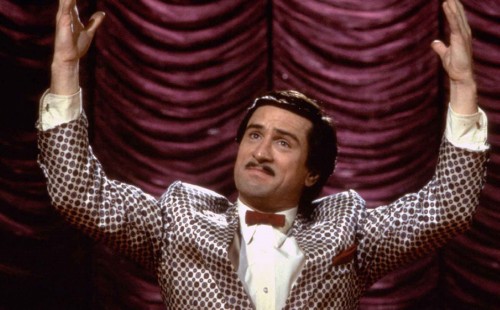
THE KING OF COMEDY
(1983, Martin Scorsese) “Better to
be king for a night than schmuck
for a lifetime.” Robert De Niro’s
terminally unfunny Rupert Pupkin,
aided by henchgal Sandra Bernhard, kidnaps his idol — TV icon
Jerry Langford/Lewis. The ransom demand? A ten-minute guest
spot on Jerry’s late-night talk show. Color; Approx. 109 minutes
1:10, 3:20, 5:30, 7:40, 9:50
“Its analysis of celebrity worship in postmodern America
makes it more timely with each passing year.”
– J. Hoberman, The Village Voice
“A masterpiece! Captures like no other movie the way
that celebrity culture has warped our fragile little minds.”
– Time Out New York
“Bristly, sometimes manic to the edge of lunacy and, along the way, terrifying.
In the way of a film that uses all of its talents to their fullest, it's exhilarating...
De Niro
gives one of the best, most complex and most flamboyant performances of his career.
It's full of laughs, but under all of the comic situations is the awful suspicion
that our laughter is going to be turned against us, like a gun.”
– Vincent Canby, The New York Times
“In many ways the evil twin of Scorsese and De Niro’s earlier poem about the humiliation of New York failure, Taxi Driver,
The King of Comedy actually moves beyond it in unsentimental candor – especially when it comes to Lewis’s frightening,
deliberately unfunny performance, and, more generally, the movie connecting an all-American hatred for one’s family with a love for celebrities.”
– Jonathan Rosenbaum
RETURN TO TOP.
DECEMBER 23/24 WED/THU (2 FILMS FOR 1 ADMISSION)
THE THIN MAN
(1934, W.S. Van Dyke) William Powell’s Nick Charles and Myrna
Loy’s perfect wife Nora take a break from cocktail quaffing to
solve a baffling murder, in the picture that wedded the whodunit
to screwball comedy. Based on the novel by Dashiell Hammett. Approx. 93 minutes
1:00, 4:40, 8:20
Listen to the complete 1936 "Lux Radio Theater" adaptation of The Thin Man, starring William Powell, Myrna Loy (and Theda Bara!), hosted by director W.S. Van Dyke II
"A classic blend of laughs and suspense which marked the first pairing of what was
to become one of the movies' great romantic teams. Shot in just two weeks,
this has gone on to become the sophisticated comedy-mystery par excellence.”
– Leonard Maltin
"Started a new cycle in screen entertainment by demonstrating that a murder mystery could also be a sophisticated screwball comedy. And it turned several decades of movies upside down by
showing a suave man of the world who made love to his own rich, funny, and good-humored wife."
– Pauline Kael
MY MAN GODFREY
(1936, Gregory La Cava) Dizzy
heiress Carole Lombard wins
the scavenger hunt by producing
bum William Powell as a
“forgotten man” — then hires him
as her butler, joining air-headed mom Alice Brady’s menagerie
of acidulous relatives and hangers-on. Approx. 95 minutes
2:50, 6:30, 10:10
“One of screwball’s greatest triumphs.
It’s one of the few movies that you can never see too many times.”
– Time Out New York
“A seamless blend of high comedy and social consciousness.”
– Dave Kehr, The New York Times
“One of the treasures of screwball comedy. God, but this film is beautiful. The cinematography is a shimmering argument for everything I've ever tried to say in praise of black and white.”
– Roger Ebert
RETURN TO TOP.
DECEMBER 25/26 FRI/SAT (2 FILMS FOR 1 ADMISSION)
MIRACLE ON 34th STREET
(1947, George Seaton) Oscar-winning Edmund Gwenn’s white-bearded
Kris Kringle is just right for Macy’s Santa — but what if
he thinks he really is Santa? Skeptical Maureen O’Hara wants
him committed, John Payne ends up defending him in court,
and precocious kid Natalie Wood
is torn. Approx. 96 minutes
1:00, 4:15, 7:30
Listen to the complete 1948 radio adaptation of Miracle on 34th Street, starring Maureen O'Hara, John Payne, Edmund Gwenn mp3 file
“Christmas has been profiled in dozens of films but seldom, if ever,
has the Yuletide been so wonderfully presented... Gwenn gives one of the most charming, endearing performances in the history of film.”
– Baseline
“It is fantastic and it is Dickensian in sentiment, but the fantasy is perfectly sustained
and the sentiment is so tempered with humor and satire that it never cloys.
The result is a joyous piece of make-believe, a picture of continuous delight.”
- A.E.Wilson, Star
CHRISTMAS IN JULY
(1940, Preston Sturges) When
he wins 25 G’s in a radio slogan
contest, success-chasing Dick
Powell showers the Lower East
Side with gifts. But there’s
just one hitch... Approx. 67 minutes
2:50, 6:05, 9:20
“Just about as cunning and carefree a comedy as any one could possibly preordain –
the perfect restorative, in fact for battered humors and jangled nerves.”
– The New York Times
“Sturges’ most whimsical movie, ironically haunted by the Depression,
is also his most socially aware satire.”
– Armond White, NY Press
“The most underrated of Sturges’ movies—a riotous comedy-satire
about capitalism that bites so deep it hurts. This captures the mood
of the Depression more completely than most 30s pictures. As usual, Sturges's
supporting cast is luminous, and he uses it like instruments in a madcap concerto.”
– Jonathan Rosenbaum
RETURN TO TOP.
DECEMBER 27/28 SUN/MON (2 FILMS FOR 1 ADMISSION)
THE PRODUCERS
(1968, Mel Brooks) Zero Mostel’s Max Bialystock, with Gene
Wilder’s hysterical nebbish accountant Leo Bloom in tow, milks
amorous old ladies to overcapitalize — to the tune of 26 thousand per cent — a sure-fire flop called Springtime for Hitler! Color; Approx. 88 minutes
Sun 2:40, 6:05, 9:30
Mon 2:40
“One of the funniest movies ever made. The whole movie is pitched at that level of frenzied desperation, and one of the many joys of watching it is to see how the actors are able to control timing and nuance even while screaming. The movie was like a bomb going off inside the audience's sense of propriety... cheerfully willing to go anywhere for a laugh.”
– Roger Ebert
“You owe it to yourself to check out this shock comedy. Wilder and Mostel give truly priceless performances.” – Time Out New York
“No bets were hedged and no throats left unthrottled. Brooks's magnum opus is still a ferocious gale of bulldozing Jewish mockery,
dominated by Zero Mostel's comb-over juggernaut. It delivers like a shorted slot machine; memories of the tame and safely distant stage version
will evaporate in the runway turbulence of Mostel's spittle-spray-in-your-eye performance. In fact, the more time passes the more combustible
Brooks's burlesque of Nazism and the post-war remnants of old-school Jewish showbiz seems.”
– Michael Atkinson, Village Voice
BROADWAY DANNY ROSE
(1984, Woody Allen) Comics gather at the Carnegie Deli to tell
the story of Woody’s Danny Rose, king of the cheap-act agents,
and his encounter with nightclub singer and Joisey moll Mia
Farrow. Approx. 86 minutes
Sun 1:00, 4:25, 7:50
Mon 1:00
“More and more, this seems like the definitive Allen comedy,
a perfect balance of nebbishment and nourishment.”
– Time Out New York
“Fantastic… while Allen’s direction invests enough care,
wit and warmth to make it genuinely moving.”
– Geoff Andrew, Time Out (London)
“The verbal wit is fast and frequently hilarious.”
– Dave Kehr, Chicago Reader
RETURN TO TOP.
DECEMBER 28 MON
(2 FILMS FOR 1 ADMISSION)
SPEEDY
(1928, Ted Wilde) Jazz Age Idols
meet, as baseball-crazed soda
jerk/cabbie Harold Lloyd and
passenger Babe Ruth hurtle to
old Yankee Stadium. Extensive
NYC location work is highlighted
during a frenzied finale, as
Harold races Gotham’s last
horse-drawn trolley right through Washington Square Arch! Silent, with musical score. Approx. 86 minutes
6:15, 9:30
“No
filmmaker had ever made such flamboyant use of New York.”
– Kevin Brownlow
THE CAMERAMAN
(1928, Edward Sedgwick) Neophyte newsreel photog Buster Keaton
loses his swimsuit at Coney Island and his heart on the streets of
Manhattan, lensing Mott Street Tong Wars while being upstaged
by monkey great Jocko. Approx. 70 minutes
4:30*, 8:00*
*Live piano accompaniment by Steve Sterner
“Keaton at the height of his art and master
of every detail of silent filmmaking.”
– Rudi Blesh
“A romantic charmer. Keaton proves his genius at creating a parabola-like farce
with what looks like a series of straight lines, whether he’s racing across town to
face his true love before she realizes that he’s off the phone or getting his
tripod leveled during a tong war by flying bullets.”
– Michael Sragow, The New Yorker
RETURN TO TOP.
DECEMBER 29 TUE (2 FILMS FOR 1 ADMISSION)
SWEET CHARITY
(1969, Bob Fosse) Fosse’s Broadway smash — a musical
version of Fellini’s Nights of Cabiria — became his feature
film debut, with Shirley MacLaine as Charity Hope Valentine,
the dancehall hostess with a heart of gold. Fosse transfers
his Tony-winning choreography to the Scope screen, with
showstopping numbers performed by MacLaine, Chita Rivera
and Paula Kelly. Screenplay by Neil Simon. Color; Approx. 133 minutes
1:30, 6:15
“A positively psychedelic Manhattan.”
– Lou Lumenick, New York Post
“This rousing musical benefits from a superlatively spunky performance by the young Shirley MacLaine.”
– Time Out New York
“An underrated musical, offering at least two classic anthology pieces:
the superbly weary, sleazy erotica of 'Hey, Big Spender', in which a row of disillusioned
taxi-dancers laconically display their wares, and the trio of bizarre fantasies performed
by a vampiric night-club dancer. The film belongs to Shirley MacLaine.”
– Geoff Andrew, Time Out (London)
MY SISTER EILEEN
(1955, Richard Quine) Singing and dancing
Jack Lemmon, Betty Garrett, Janet Leigh,
and young Bob Fosse (also making his
solo choreography debut) light up this
alternative musical about the adventures
of two Ohio sisters in Greenwich Village (the
other was Comden & Green’s Broadway
hit Wonderful Town). Color; Approx. 108 minutes
4:10, 9:00
RETURN TO TOP.
DECEMBER 30 WED (2 FILMS FOR 1 ADMISSION)
SWING TIME
(1936, George Stevens) “No one could teach you to dance
in a million years!” After signing up for dance lessons(!),
Fred Astaire — remembering his vows to girl-back-home Betty
Furness — has “a fine romance”
with Ginger Rogers. The pinnacle
of the Astaire-Rogers series.
Approx. 103 minutes
1:00, 4:35, 8:10
“A jaunty little masterpiece.”
– Time Out New York
“The best of the Astaire-Rogers films.”
– Roger Ebert
“Nothing Fred and Ginger did together surpasses their lengthy,
climactic duet, taking off from ‘Never Gonna Dance’,
which reminds you that dance is the most perfect sexual metaphor of them all.”
– Time Out (London)
BACHELOR MOTHER
(1939, Garson Kanin) “You’ve
disgraced the toy department!”
Ginger Rogers, stuck with an
abandoned baby, finds herself an
unwed mother — but department
store owner Charles Coburn
beams with grandfatherly pride when love-sick scion David
Niven determines to “save her.” Approx. 81 minutes
3:00, 6:35, 10:10
“It's a hilarious, snappy, loose-jointed comedy in the best Hollywood tradition,
but the script and direction by Kanin have an intelligence and sense of irony
which raise provocative question after provocative question … A salutary reminder
that Sirk wasn't the only 'subversive' to burrow his way into the woodwork of tinsel city.”
– Time Out (London)
RETURN TO TOP.
DECEMBER 31/JANUARY 1 THU/FRI
(2 FILMS FOR 1 ADMISSION)
THE APARTMENT
(1960, Billy Wilder) Jack Lemmon’s Bud Baxter trades the key to
his Upper West Side pad for the key to the executive washroom
— then finds users have been boss Fred MacMurray and
his own beloved elevator operator Shirley MacLaine.
Wilder won an unprecedented three Oscars: for
writing (with I.A.L. Diamond), directing, and producing
the year’s Best Picture. Approx. 125 minutes
1:10, 5:30, 9:50
“Classic New York movies don't get much more 'classic New York'
than Wilder's withering satire. A GREAT WAY TO USHER IN THE NEW YEAR!”
– The Onion AV Club
“One of the most indelible New York visions of all. The cynicism and casual cruelty
that set in motion Wilder’s tale of sexual and professional humiliation, and of love in the ashes,
are as lacerating today as they were in 1960.”
– Janet Maslin, New York Times
"This is Hollywood filmmaking at its absolute finest." – Time Out New York
“A dirty fairy tale.” – Saturday Review
“Wilder's vision was never more jaundiced than in this acerbic view of the corporate hive. Its full of sly bits...The sets by the great Alexander Trauner are first-rate."
– Elliott Stein, Village Voice
“Diamond-sharp satire…Lemmon and MacLaine commute between comedy and pathos with delicate skill.”
– Tom Milne, Time Out (London)
 |
Ring In The New Year With Jack & Shirley!
Join us for a complimentary glass of bubbly,
following the
9:50 screening of The Apartment on New Year’s Eve!
(7:40 & 9:50 “Madcap Manhattan” ticketholders only) |
 |
BREAKFAST AT TIFFANY’S
(1961, Blake Edwards) Audrey Hepburn’s Holly Golightly
defined the New Yorker as “kook,” in George Axelrod’s
bright adaptation of the Truman Capote novella, with
love interest George Peppard, love rival Patricia Neal,
and the Oscar-winning “Moon River.” Color; Approx. 115 minutes
3:20, 7:40
“When Holly says ‘I love New York,’ you love it for all the magic
she herself brings the mythology of a great city. Blake Edwards,
one of the best filmmakers of the last forty years, understood this profoundly;
its clear by the way he brings Hepburn into the film at the very beginning.”
– Peter Bogdanovich
“Holly Golightly is perhaps the ultimate Manhattan party girl.”
– Lou Lumenick, New York Post
RETURN TO TOP.
JANUARY 2 SAT (2 FILMS FOR 1 ADMISSION)
THE SEVEN YEAR ITCH
(1955, Billy Wilder) With the dog days already melting the
asphalt, pulp mag editor Tom Ewell packs the wife and kid off
to Maine, while he holds the fort in sweltering NYC. But with
the arrival of a new upstairs neighbor — Marilyn Monroe (!)
— it’s time to scratch that itch. And
if Rachmaninoff doesn’t do the trick,
there’s still the thrill of watching her
cool off over a subway grate on a
sultry summer night.
Color; Approx. 105 minutes
1:30, 5:40, 9:50
"The laughs come thick and fast with Marilyn Monroe as the dumb-but-sweet number upstairs."
– Variety
“Very 'New Yorkerish' and full of funny and unedifying wisecracks.”
– Philip Hope-Wallce, The Guardian
IT’S ALWAYS
FAIR WEATHER
(1955, Gene Kelly & Stanley Donen)
Betty Comden & Adolph Green’s On
the Town follow-up, as wartime buddies Gene Kelly, Dan Dailey
and Michael Kidd find their 10th anniversary reunion a frost, but
still manage to stop the show with their widescreen-tri-secting
“garbage can ballet.” Plus knock-out Cyd Charisse and Gene’s
dazzling dance on roller skates. Color; Approx. 102 minutes
3:30, 7:40
“One of Donen's most formally perfect works—
innovative, involving, and, in case there's any doubt, finally optimistic.”
– Dave Kehr
“An exhilarating follow-up to On the Town.”
– Geoff Andrew, Time Out (London)
RETURN TO TOP.
JANUARY 3 SUN (2 FILMS FOR 1 ADMISSION)
EASY LIVING
(1937, Mitchell Leisen) Working girl Jean Arthur is bonked on the
head with a mink coat while riding on an open-air Fifth Ave bus,
mistaken for the mistress of Wall St. lion Edward Arnold, given the
ne plus ultra of Manhattan penthouse suites, and finds love in
the Automat with fresh-faced Ray Milland. Screenplay by Preston
Sturges. Approx. 86 minutes
2:00, 5:40, 9:20
“One of the most pleasurable of the romantic slapstick comedies of the 30s,
and full of surprises.”
– Pauline Kael
“A blithe romantic comedy. You can already hear the beginnings of the trademark 90mph banter and dizzying dialogue exchanges that Preston Sturges would later perfect,
along with his knack for turning battle-of-the-sexes frisson into comic fold.”
– David Fear, Time Out New York
"The characterizations are memorably colorful, right down to the bit players, and the improbable plotlines are artfully contrived.
But what really wows is the snap crackle pop of the letter-perfect repartee."
- Paul Brunick, BOMB Magazine Click here to read the entire review
THE DEVIL AND MISS JONES
(1941, Sam Wood) Burned in effigy, department store magnate
Charles Coburn goes leftist-hunting in shoe clerk guise, only to be
befriended and discreetly romanced respectively by employees
Jean Arthur and Spring Byington, then arrested during a Coney
Island outing. 35mm archival print
courtesy UCLA. Approx. 92 minutes
3:45, 7:25
“Attractive comedy with elements of the crazy thirties
and the more socially conscious forties.”
– Leslie Halliwell
“The frothiest comedy since The Lady Eve. Clicks off laughs
like the ticking of a clock.”
– The New York Times
“One of the funniest and most finely crafted comedies of the Forties. The impossibly lavish, intricately worked design of Merrick's mansion
and the soullessly modernistic department store contribute much to the atmosphere without stealing attention away from the performances.
Wood uses camera placement, mise-en-scene and repeated actions for comic effect.”
– James Steffen
RETURN TO TOP.
JANUARY 4 MON
(2 FILMS FOR 1 ADMISSION)
LADY FOR A DAY
(1933, Frank Capra) Gambler Dave the Dude (Warren William)
and his motley gang of guys and dolls turn haggard fruit
peddler Apple Annie (May Robson) into a society grand dame in
preparation for a visit by her aristocratic daughter, in this height-of-the-Depression picture adapted (by Robert Riskin) from the
Damon Runyon story “Madame La Gimp.” Approx. 96 minutes
1:00, 4:25, 7:50
Listen to the complete 1939 radio adaptation of Lady for A Day, starring Warren William, May Robson, Jean Parker, and Guy Kibbee mp3 file
“Splendid sentimental comedy full of cinematic resource;
the best translation of Runyon to the screen.”
– Leslie Halliwell
“Has Capra's trademark down-to-earth outlook as it blends poignancy and humor.”
– Janet Maslin, The New York Times
“Riskin's razor-sharp dialogue is matched by Capra's super-subtle visuals, and backed by an array of suitably Runyonesque characters. In fact it is just about worth swallowing your cynicism (and scruples) for Ned Sparks' definitive stone-faced Broadway sharpie alone.”
– Geoff Andrew, Time Out (London)
“A breakthrough. The struggle between head and heart—the conflict that underlies all Capra’s work—
had its first full expression in this fable of camaraderie among the outcasts.”
– Andy Klein
LITTLE MISS MARKER
(1934, Alexander Hall) After a perennial racetrack loser ends it
all when that sure thing loses, slick bookmaker Adolphe Menjou
gets stuck with his marker—only trouble is, it’s six-year-old
Shirley Temple, in her first major role en route to super-stardom.
Adapted from a Damon Runyon story. Approx. 80 minutes
2:50, 6:15, 9:40
“Don't tell anybody that you missed it. Because you'll be listed among the clucks.”
– Walter Winchell
“A masterpiece... it succeeds because the humor plausibly exists side by side with a nightmarish landscape of death and corruption—actual Manhattan as opposed to movie Manhattan.”
– Sarahjane Blum, The Brooklyn Rail
“Only a dyed-in-the-wool cynic could fail to be affected by its sterling humor and pathos.”
– The New York Times
“No one can deny that the infant was a trouper: she delivers her lines with a killer instinct.”
– Pauline Kael
“Clean, funny, with thrills and heart appeal all nicely blended.”
– Variety
RETURN TO TOP.
JANUARY 5 TUE (2 FILMS FOR 1 ADMISSION)
TAKING OFF
1971, Milos Forman) In desperate search for their runaway daughter
through East Village hippie enclaves, Buck Henry and Lynn Carlin
resort to the ultimate — trying marijuana themselves! Forman’s first
American film gives not only the middle class squares, but also those
would-be radicals, a comic workout. Color; Approx. 93 minutes
3:15, 7:20
Listen to our podcast: TAKING OFF: Q & A with director MILOS FORMAN
(Recorded January 5, 2010)
“The sweetest of generation-gap movies.
Wackier and more expansive than Forman’s previous films.”
– J. Hoberman
"At times it is so funny you dare not laugh in case you miss something and as always
with Forman often you can't quite laugh because it's so poignant and so interesting.”
– The Times (London)
“Moral issues go down the toilet during Mayor Lindsay's reign, as this film from 1971 illustrates, with varying degrees of paranoia and nihilism,
the craziness of living in Zoo York. Lynn Carlon and Buck Henry leave the comfort of their Forest Hills home,
discovering the East Village, pot, the Society for Parents of Fugitive Children – and Ike and Tina Turner.”
– Melissa Anderson, The Village Voice
A THOUSAND CLOWNS
(1965, Fred Coe) Jason Robards’ Murray Burns quits the
Chuckles the Chipmunk Show rat race to play his ukulele,
exchange movie quotes with super-precocious nephew Barry
Gordon, and romance nervous social worker Barbara Harris.
Screenplay by Herb Gardner, from his play. Approx. 118 minutes
1:00, 5:05, 10:00
“A story so quintessentially New York-ish that it could never have been imagined elsewhere.”
– Janet Maslin, New York Times
“This paean to nonconformity is worth seeing for Robard's energetic performance,
as well as fine supporting turns by Barbara Harris and Martin Balsam.”
– Time Out New York
RETURN TO TOP. |