






SEPTEMBER 12/13 FRI/SAT (2 FILMS FOR 1 ADMISSION)
“The most robust rebuke to any declaration that movies and literatures don’t mix.
The truest expression of Lean: there is both largesse and particularity in them, and room for doubt. ”
– Anthony Lane, The New Yorker
“Lean’s care pays off in the increased density and vibrancy of the images, and—gratifyingly, a little surprisingly—
a heightening of those big, unsubtle Dickensian emotions.”
– Terrence Rafferty, The New York Times
"These sophisticated adaptations distilled Dickens to cinematic essence. It's as if those books were suddenly lit from within and their meanings made radiant. Every image, camera movement, every edit and sound communicates ideas."
– Armond White, New York Press. Click here to read full article.
GREAT EXPECTATIONS

(1946) From the electrifying appearance of Finlay Currie’s convict, the great literary adaptation, Dickens’ story of an orphan enriched by a mysterious benefactor. The director’s first non-Noël Coward adaptation features Anthony Wager/John Mills and Jean Simmons/Valerie Hobson as the young/adult Pip and Estella, Martita Hunt as Miss Havisham, Alec Guinness (in his first major film role) as Herbert Pocket, and Francis L. Sullivan (Night and the City) as Mr. Jaggers. "Dickens was a superb screenwriter." – David Lean. Oscars for production designer John Bryan and cinematographer Guy Green, plus nominations for Picture, Direction and Screenplay. Approx. 118 min.
1:00, 5:25, 9:50
"Lean brings Dickens' classic set-pieces to life as if he'd been reading over our shoulder... Made by Lean at the top of his early form."
– Roger Ebert
“One of the best openings in the history of film. Every time I watch the film, I imagine spiriting Dickens into a cinema and watching his response—his recognition of treasures from the book, carried over and minted afresh.”
– Anthony Lane, The New Yorker
"Lean's robust, visually dazzling adaptation brings real vitality and flavor to the old literary classic."
– The Onion AV Club
"The definitive screen version. A genuinely affecting and visually imaginative melodrama about the cruelty and deception of love."
- Elliott Stein, Village Voice
“A handsome production. The film has a strong style that is very different from Lean’s earlier work. Emotional, exciting, full of action; sequences are planned in terms of heightened dramatic contrasts and sudden, scary tensions. The cast is close to miraculous.”
– Pauline Kael
OLIVER TWIST

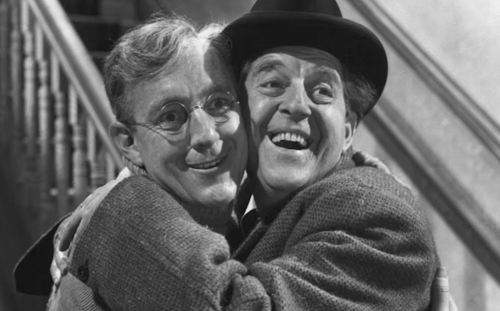
(1948) From its ominously storm-ridden opening, Lean’s child’s-eye-view adaptation of Dickens’ classic about a London waif trapped in a pickpocket gang is alternately humorous and hair-raising, notably in the dog desperately scratching at the closed door and Robert Newton’s taut conclusion as Bill Sikes. With John Howard Davies as Oliver and a young Anthony Newley as the Artful Dodger. Original U.K. version; the U.S. version was edited to tone down Alec Guinness’ scenery-chewing Fagin (played with a “sly, depraved charm” – Pauline Kael). Approx. 115 min.
3:15, 7:40
“Ravishing still: magnificent in its period recreation, its rank city, and its evil; it is greedily edited and beautifully designed, and shot in sooty shadow and imperiled light, with great performances.”
– David Thomson
“Vastly clever - harsh, ugly, sly, unwholesome, yet curiously appealing.” - The New York Times
“From the movie's stormy prologue to its climactic rooftop chase, Lean propels Dickens's tale of a crime-buffeted orphan with stylized sequences that connect in electric arcs. He surrounds his limpid, poignant Oliver with a terrifying and delightful rogues' gallery.”
– Michael Sragow, The New Yorker
RETURN TO TOP.
SEPTEMBER 14/15 SUN/MON (2 FILMS FOR 1 ADMISSION)
BRIEF ENCOUNTER

(1945) Suburban housewife Celia Johnson, on her weekly trip to town, meets equally married doctor Trevor Howard, and a tender, doomed love affair begins. Both contracted and expanded from Noël Coward’s one-acter, this is the most romantic of films, unforgettably underscored by Rachmaninoff’s Piano Concerto #2. “Its simplicity remains unsurpassed.” – Derek Malcolm, The Guardian. Johnson's performance garnered an Oscar nomination and an NY Film Critics' Award. Approx. 86 min.
2:50, 6:20, 9:50
"ONE OF THE GREATEST SCREEN ROMANCES EVER MADE!" – Time Out New York
“Perhaps the closest to perfection Lean ever came. A nearly flawless romantic artifact.” – Terrence Rafferty, The New York Times
“Its simplicity, one of the most difficult things to achieve, remains unsurpassed.”
– Derek Malcolm, The Guardian
“REMAINS THE DEFINITION OF TIMELESS, a beautifully shot, heartbreakingly acted, minutely detailed illustration of thoroughly recognizable human frailty… As confined, brisk, and economical as Lean's later work is sprawling. Not only does the director make an entire world out of the film's environments—train stations, movie theaters, mid-tier restaurants—but he also fills them with unforgettably drawn characters.”
– Keith Phipps, The Onion AV Club
“One of the great British classics.” – Roger Ebert
"The most intense movie ever made about stages of lust."
– Armond White, New York Press. Click here to read full article.
“Brief Encounter, as a study of basic relationships of its time, stands out as a beacon throughout the whole of British cinema.
A totally adult film, expressing an essential Englishness.”
– George Perry
BLITHE SPIRIT

(1945) The dangers of research, as novelist Rex Harrison, investigating spiritualism, finds his séance going awry when eccentric medium Madame Arcati (the scene-stealing Margaret Rutherford) conjures up his first wife—to the chagrin of his second. Shot in vibrant Technicolor, with ghost Kay Hammond, fresh from the five-year run of Noel Coward's stage triumph, remaining green throughout, and her bonding with long-suffering #2 Constance Cummings leaving Harrison trapped in supernatural bigamy. Oscar for Special Effects—Lean’s only use of them. Approx. 95 min.
1:00, 4:30, 8:00
“A classy adaptation with nifty special effects, and plenty of Coward's inimitable wit and repartee.”
– Time Out (London)
"Preserves much of the play's wit , with a priceless performance by Margaret Rutherford." – Elliott Stein, Village Voice
"Played to perfection by the cast. And a lovely use of color." – Time Out New York
“A work of art has been correctly translated from one medium to another.”
– Simon Harcourt-Smith, Daily Mail
“Whenever Margaret Rutherford is on screen, as the medium who starts and tries to control the trouble, the picture is wonderfully funny.”
– James Agee, Nation
“Lean brings something to the haunting that Coward did not envisage:
in a few shots of restless curtains and dark doorways, he made it scary.”
– Anthony Lane, The New Yorker
RETURN TO TOP.
SEPTEMBER 16 TUE (2 FILMS FOR 1 ADMISSION)
“Lean’s series of Ann Todd films is an intriguing one, unjustly forgotten, not just for her acting but for her role as muse,
as
inspiration in Lean’s pushing of classical film form, and the stylized oscillation of romance and restraint that shapes so much of his work.”
– John Orr, Senses of Cinema
THE PASSIONATE FRIENDS

(1949) As illicit lovers Trevor Howard and Ann Todd exchange guilty looks over cocktails, knowing husband Claude Rains smilingly offers "Ice?" Because of its upper-class milieu and Swiss locations, often dismissed as "Brief Encounter with glamour", this is in fact Lean's most complexly structured work, its flashbacks within flashbacks—plus subjective flash-forwards—rivaling Resnais for narrative complexity; while its theme—one of the few elements retained by spy fiction legend Eric Ambler from H.G. Wells' original—of a woman's need for independence, remains provocative. Approx. 91 min.
3:40, 7:35
"NOT TO BE MISSED!" – Andrew Sarris
“Lean’s film most deserving recovery.” – David Thomson
"THE GREATEST REDISCOVERY AT FILM FORUM! Startling and awe-inspiring. Lean does audacious experiments throughout... judiciously applied to moments of ecstasy and hysteria. Ann Todd is terrific - the screen's most catastrophically sexual Caucasian woman until Naomi Watts in Mulholland Drive. NOT MERE MELODRAMA. FOR A MOVIE LOVER, IT'S AN EPIPHANY."
– Armond White, New York Press. Click here to read full article.
“An illuminating reissue. The storytelling looks decidedly modern, and Lean’s direction works the material for all its expressive worth.
Rains steals the show, his clipped exterior masking unexpectedly touching feelings for his errant spouse.”
– Time Out (London)
“At times Lean photographs Todd in the style that Lee Garmes adopted for the Dietrich of Sternberg’s 1930s melodramas for this meditation on time. Lean borrows from Citizen Kane—deep focus and multiple flashback—that become a technical foundation for romantic delirium. The film points forward to the modernist deconstruction of romance in Vertigo and Last Year at Marienbad.”
–James Orr, Senses of Cinema
"Cinematically classical but also bracingly modern, anticipating Antonioni’s L’Eclisse. Combinations like that make for timeless film."
–
Glenn Kenny
MADELEINE
 (1950) 1857: merchant’s daughter Ann Todd (then Mrs. Lean) finds penniless ex-lover Ivan Desny won’t stay ex-, despite her impending engagement — so... Lean’s treatment of 19th century Britain’s real-life equivalent of the O.J. Simpson trial is a tour de force of ambiguity, acting, and pure filmmaking. Approx. 114 min.
1:30, 5:25, 9:20
"ONE OF LEAN'S UNSUNG MASTERPIECES... Lean's deep-focus compositions and chiaroscuro evoke the sumptuous historicism of The Magnificent Ambersons. Seeing this movie is like touching it."
– Armond White, New York Press. Click here to read full article.
“A STAGGERING PERIOD FILM NOIR.” – David Thomson
“A cloistered Victorian marriage forensic featuring a spectacularly nuanced performance from Ann Todd.”
– Bruce Bennett, The New York Sun
“Where the film is remarkable is in never allowing Ann Todd’s Madeline to become simply a victim. She dares to expose and enjoy her sensuality, and cunningly exploits the prim reticence expected of a Victorian miss to avoid submission to marriage, deflecting the hostile gaze of outraged society with a proudly enigmatic vanity.”
– Time Out (London)
RETURN TO TOP.
SEPTEMBER 17 WED (2 FILMS FOR 1 ADMISSION)
HOBSON’S CHOICE
(1954) Early 20th century Lancashire bootmaker Charles Laughton lords it over his three daughters and nerd assistant John Mills while lolling in the pub, but eldest daughter Brenda de Banzie has other plans. Lean's last comedy finds one of his trapped, repressed women triumphing at last—amid the trappings of Expressionism: Laughton's DT visions and the tour de force chase of the moon's reflection from puddle to puddle. British Oscar, Best Picture. Approx. 107 min.
1:15, 5:30, 9:45
“Lean creates humorous cadenzas by linking his camera movements and the soundtrack music. The wonderfully zesty performers - at times, Mills suggests Chaplin - give the material a vaudevillian lift. Seeing this, you realize what a shame it is that Lean has never directed a full-fledged musical comedy.”
– Michael Sragow, The New Yorker
“Lean's sharp direction and impeccable performances all round transform a slight comedy into a timeless delight.” – Time Out (London)
“Graceful and wry and quickened from time to time by nicely choreographed set pieces of physical comedy.
Like River Kwai would later be, an ambivalent portrait of a pathologically controlling man.”
– Terrence Rafferty, The New York Times
“Charles Laughton is superbly vulgar in this whack at the backside of Victorianism.
He makes a great vaudeville turn out of the role of an egocentric scoundrel.”
– Pauline Kael
THE SOUND BARRIER
(1952) “A piece of cake” scoffs pilot Nigel Patrick to Ann Todd, but, before the ultimate triumph of aircraft exec Ralph Richardson's dreams, Lean's camera—in one of his greatest moments—will inexorably track to a smoking hole in the ground. His first original story, dramatized by Terence Rattigan, this is total fiction—although actual barrier breaker Chuck Yeager "thoroughly enjoyed" himself at the premiere—but is, even today, perhaps the screen's greatest evocation of speed. Oscar for Best Sound, British Best Film Oscar, NY Film Critics' Award to Richardson. Approx. 116 min.
3:20, 7:35
“Shows Lean refining his judgment of light and shade, and probing the uncertainties that lurk in chiaroscuro. A tribute to the silent movies that had been Lean’s education in cinema.”
– Anthony Lane, The New Yorker
"Recommended! Has much the same feel as the early parts of The Right Stuff - a charmer haunted by danger."– Time Out New York
“It cannot be often that a film critic wants to applaud before the [opening] credits have appeared on the screen, but that is what
I felt like doing. I have never seen aerial photography so beautiful and so stirring. Lean has found a theme which engages all his talents.
Imaginative, remarkable… I found myself crying Bravo.”
– Dilys Powell
RETURN TO TOP.
SEPTEMBER 18 THU (2 FILMS FOR 1 ADMISSION)
IN WHICH WE SERVE
(1942, Noël Coward & David Lean) As the survivors of H.M.S. Torrin cling to a lifeboat amid oil-streaked waters, flashbacks unroll toward the Home Front: Captain Noël Coward delivers staccato compliments to wife Celia Johnson at cocktail time; CPO Bernard Miles good-humoredly contends with Mother-in-Law; Seaman John Mills romances Kay Walsh (then Mrs. Lean). Coward fictionalized his friend Lord Mountbatten’s career, then recruited ace editor Lean to co-direct. Best Film, New York Film Critics. Approx. 114 min.
1:00, 5:15, 9:30
“A strange blend of grand-scale naval battle scenes and flashbacks to the mundane lives of the British seamen and their families, both a stirring exercise in patriotic propaganda and an anthology of cozy sentimental vignettes. An enormous success.”
– Terrence Rafferty, The New York Times
“The best movie we have had about the war.
Full of sequences moving and memorable.”
– Dilys Powell
"Co-directing films with Coward instilled in Lean a distinct appreciation for characterization as well as a flawless sense of dramatic structure - such that Spielberg copied In Which We Serve for the dramatic climax of Schindler's List."
– Armond White, New York Press. Click here to read full article.
“Lean ensured that the action scenes were graphically staged, shot and cut,
and he imbued the whole film with a visual authenticity and documentary integrity."
– Jeffrey Richards, Daily Telegraph
“The finest war drama produced yet and because of the strength of its understatement and recognition
occasionally of human weakness if propaganda of the very best sort. It should be seen by all.”
– Monthly Film Bulletin
THIS HAPPY BREED 
(1944) Twenty years in the life of 17 Sycamore Road, Clapham, as returned WWI vet Robert Newton and his family move into their first unshared house, and then — after youthful radicalism, a tragic auto accident, the General Strike, a family scandal, and the coming of a grandchild — move on as a new war looms. The surface complacency of Noël Coward’s story is jarred by the tightly wound, neurotic performance of Celia Johnson as the wife. Lean’s first in color. Approx. 110 min.
3:10, 7:25
“Lean and Coward’s adventurous excursion into suburban Clapham remains ENDLESSLY FASCINATING.”
– Time Out (London)
“Remarkably modern and subdued use of Technicolor.” – Bruce Bennett, The New York Sun
“Lean took every mundane event the cinema avoided—washing up, drying clothes, a great many meals—and worked the dialogue into them. For a British film to do this was unusual enough, but to show the kitchen sink was revolutionary.”
– Kevin Brownlow
“The observation of character and habit and the delicacy and humor of its communication are astonishing.
Celia Johnson gives a performance without a fault, which makes most Oscarboys look like failed B.A.’s.”
– Dilys Powell
RETURN TO TOP.
SEPTEMBER 19/20 FRI/SAT
LAWRENCE OF ARABIA
(1962) WWI in the Middle East and British Colonel T.E. Lawrence leads the Arab revolt — but sheik Anthony Quinn still grouses, “He is not perfect.” Lean’s epic — still the standard by which others are measured — delivered both spectacular action and, in then-nearly-unknown Peter O’Toole’s title performance, one of the cinema’s most complex and enigmatic character studies. Seven Oscars, including Best Picture. Approx. 216 min. + intermission.
2:00, 7:00
"CONNOISSEURS SHOULD MAKE THEIR WAY TO FILM FORUM.
The sheer majesty will never translate at home, no matter how wide your flat screen is."
– Joshua Rothkopf, Time Out New York
“What a bold, mad act of genius it was, to make Lawrence of Arabia, or even think that it could be made…The impulse to make this movie was based, above all, on David Lean’s ability to imagine what it would look like to see a speck appear on the horizon of the desert and slowly grow into a human being. A movie that uses the desert as a stage for the flamboyance of a driven, quirky man… to see it on the big screen is on the short list of things that must be done during the lifetime of every lover of film.”
– Roger Ebert
“One of the Seven Wonders of the cinematic world.” –The Los Angeles Times
"Certainly one of the greatest films ever made. Its awesome spectacle has obscured its precise psychological detail,
grasp of history, and astonishing craft."
– Armond White, New York Press. Click here to read full article.
“Lean summoned his earliest memory of awe and restored out illusion that a mass medium could be a miracle…
The big screen is its natural habitat—the only place, you might say, where its proud and leonine presence has any meaning.”
– Anthony Lane, The New Yorker
“Set a new standard for the spectacular, for beyond being an absorbing and exotic adventure story it provides a subtle exploration
of the eternal enigma of one of the most intriguing of our century's heroes.”
– Judith Crist
“Remains one of the most intelligent, handsome, and influential of all war epics. Combining the scenic splendor of De Mille with virtues of the English theater, Lean endeared himself to English professors and action buffs alike.”
– Jonathan Rosenbaum
“As shockingly beautiful and hugely intelligent as any film ever made.” – Total Film
"The most singularly original of all wide-screen epics." – David Ehrenstein, ArtForum
RETURN TO TOP.
SEPTEMBER 21/22 SUN/MON
THE BRIDGE ON THE RIVER KWAI
 
(1957) “Madness, madness.” To American prisoner William Holden’s disgusted disbelief, British colonel Alec Guinness leads his ragged men into Japanese captivity to the strains of the “Colonel Bogey March.” Then, after suffering torture to get camp commandant Sessue Hayakawa to play by the rules, Guinness proceeds to build them their bridge anyway. The first of Lean’s widescreen epics balanced spectacle, character study, and anti-war message, and nabbed seven Oscars, including Best Picture, Actor, and Director. Approx. 161 min.
Sun 1:30, 4:30, 7:30
Mon 1:30, 4:30
“If ever there was a nearly perfect motion picture in every way this is it.”
- James Powers, Hollywood Reporter
“David Lean has directed it so smartly and so sensitively for image and effect that its two hours and forty-one minutes seem no more than a swift, absorbing hour. In addition to splendid performance, he has it brilliantly filled with atmosphere—the atmosphere of war's backwash and the jungle—touched startlingly with humor, heart and shock. Alec Guinness gives one of the most devastating portraits of a militarist that we have ever seen. HERE IS A FILM WE GUARANTEE YOU WON’T FORGET.”
– The New York Times
“Unique in its success on three levels: as a taut adventure-suspense story that sags not for a second in its two hours and forty minutes; as a psychological study of a variety of men in a non-combat war situation; and as a beautiful example of the perfections of every aspect of cinematic art.”
– Judith Crist
“Lean established himself as one of the biggest money-making directors in the world with this epic entertainment.”
– Elliott Stein, Village Voice
RETURN TO TOP.
SEPTEMBER 22 MON (Separate Admission)
RYAN’S DAUGHTER
(1970) As revolution looms in 1916 Ireland, romantic young Sarah Miles weds her mentor, schoolmaster Robert Mitchum — but then wounded British officer Christopher Jones arrives to convalesce. Freddie Young’s Oscar-winning photography of Ireland’s wind-swept western coast lends a Hardyesque tone of nature’s dominance over man. With memorable supporting performances by Leo McKern, Trevor Howard, and an Oscar-winning John Mills as the village idiot. Approx. 194 min. + intermission.
7:30 ONLY
"Ripe for reappraisal!" – David Ehrenstein, ArtForum
"It's fitting that Film Forum resurrect's Ryan's Daughter, giving viewers the opportunity to finally understand Lean's most trammeled intimate-epic, summing-up his misunderstood artistry."
– Armond White, New York Press. Click here to read full article.
“David Lean finally got some madness going in his images with this 1970 production.
Somehow the crazy mismatches in scale contribute to the film's sense of romantic delirium.”
– Dave Kehr
“Has the best storm: the best, the most splendid, the most terrifying.
Sarah Miles is full of exquisite life; Robert Mitchum is a surprise, in a mood of wistfulness.”
– Dilys Powell
RETURN TO TOP.
SEPTEMBER 23 TUE
SUMMERTIME
(1955) Europe at last, as Katharine Hepburn’s spinsterish Akron secretary reaches Venice — and, after a canal dunking, romance with married Rossano Brazzi. Lean’s first film away from Britain altered the original play (“The Time of the Cuckoo”) in favor of the next-to-last of his repressed women. Oscar nominations for Actress and Director, plus New York Critics’ Award to Lean. Approx. 99 min.
1:30, 3:30, 5:30,
7:30, 9:30
RETURN TO TOP.
Click here to read
David Denby's essay on SUMMERTIME
"That most deluxe of Katherine Hepburn romances." – David Ehrenstein, ArtForum
“A tremendously romantic rhetoric of high order. The beauty is overwhelming, and no one was ever so responsive to ‘views’ as Katharine Hepburn. The sunshine is inescapable; even when the shades are drawn, it spills around the edges… Hepburn falling in love is a miracle, Lean's technique has never been smoother or more tactful."
– David Denby
"I've put more of myself in that film than in any other I've ever made."
– David Lean
“Katherine Hepburn is... [so] stylish and delightful and Jack Hildyard has photographed her so beautifully... that it hardly matters what [the film] is about. The acting and the travelogue, not the play, are the thing, and they turn a well-contrived piece of glossy romanticism into something sparkling.”
– Thomas Spencer, Daily Worker
“The challenge thus set of making Venice the moving force in propelling the play has been met by Lean with magnificent feeling and skill. Through the lens of his color camera, the wondrous city of spectacles and moods becomes a rich and exciting organism that fairly takes command of the screen. And the curious hypnotic fascination of that labyrinthine place beside the sea is brilliantly conveyed to the viewer as the impulse for the character's passing moods.”
–The New York Times
RETURN TO TOP.
SEPTEMBER 24 WED
DOCTOR ZHIVAGO
(1965) Against a spectacular recreation of the Revolutionary years, Omar Sharif’s Doctor/poet Zhivago, torn between wife Geraldine Chaplin and fated mistress Julie Christie, flees Red squalor for ... Siberia! Exchanging sand for snow, the crew of Lawrence combined stunning realism and breathtaking wilderness scenery to produce a movie of unparalleled lyrical beauty. From Nobel winner Boris Pasternak’s banned-by-the-Soviets novel. Nominated for ten Oscars and took home five for Art Direction, Cinematography, Costume Design, Score, and Adapted Screenplay. Approx. 197 min. + intermission
2:00, 7:00
“If this be soap, it is not the soft stuff of the soap opera but rather that of the surgery - harsh, astringent, purifying. That it cannot wash away the revolution is a measure of the historical event’s terrible force... At once generous yet austere, huge but never out of human scale, gently unfolded yet full of power, it is work of serious, genuine art. That such a work could be created within the conventions of the commercial cinema is almost as miraculous as the fact that a novel celebrating the unconquerable individualist could come out of modern Russia.”
– Richard Schickel
"Hollywood's last great romantic epic... A Panavision marvel of snow-swept vistas, ice-glazed architecture, and elegantly choreographed legions of extras."
– Entertainment Weekly
“The decor and color photography are as brilliant, tasteful, and exquisite as any ever put on the screen.” – The New York Times.
RETURN TO TOP.
SEPTEMBER 25 THU
A PASSAGE TO INDIA
(1984) On a trip to the sub-continent in the 20s, Judy Davis decides not to marry companion Peggy Ashcroft’s son, then is assaulted on a visit to the Malabar caves by local doctor Victor Banerjee — or is she? Adapting E.M. Forster’s greatest novel, Lean triumphantly returned to filmmaking after a decade’s absence. Oscar-nominated for Best Picture, Director, Actress and Screenplay, with Dame Peggy winning for her last film. Approx. 163 min.
1:00, 4:20, 7:40
“ONE OF THE GREATEST ADAPTATIONS I HAVE EVER SEEN... Lean places these characters in one of the most beautiful canvases he has ever drawn. He doesn't see the India of travel posters and lurid postcards, but the India of a Victorian watercolorist like Edward Lear, who placed enigmatic little human figures here and there in spectacular landscapes that never seemed to be quite finished. Lean makes India look like an amazing, beautiful place that an Englishman can never quite put his finger on.”
– Roger Ebert
“Though vast in physical scale and set against a tumultuous Indian background, it is also intimate, funny and moving in the manner of a film maker completely in control of his material… A wonderfully provocative tale, full of vivid characters, all played to near perfection.”
– Vincent Canby, The New York Times
Click here to read the entire review
“This admirable version was adapted, directed, and edited by David Lean, who knows how to do the pomp and the moral hideousness of empire better than practically anybody else around. Peggy Ashcroft comes through with a transcendent piece of acting and Judy Davis is close to perfection.”
- Pauline Kael
“Lean's old-world sensibility makes A Passage To India effective. Lean's final film is just as meticulously designed as Lawrence or River Kwai, because more than any other filmmaker of his era, he understood how the right hat could say as much about a character —and a society—as any line of dialogue.”
– Noel Murray, The Onion AV Club
RETURN TO TOP.
|