











PREVIOUSLY AT FILM FORUM JULES DASSIN 1911-2008; MARCH 27-APRIL 7 12 DAYS! “Dassin’s shocking specialty: a kind of stif led vio lence that one fears wi ll explode !” – Pauline Kael


“Dassin's characteristic movies combine Pop Front sentimentality and pulp fiction violence; his directorial style is at once overtly theatrical and cannily neo-realist. The hybrid was his forte.” – J. Hoberman, The New York Times Click here to read The Village Voice article on the seriesClick here to read the Moving Image Source article by Bruce Bennett

NEVER ON SUNDAY. Click here for more information

“A master movie craftsman.” – Michael Sragow  “A fascinating, hard-to-pin-down ex-pat auteur.”  – Richard Corliss, TIME Click here to read entire article  “Dassin's style behind the camera was elegant and sharp... Truffaut considered Rififi the best thriller ever, although all of Dassin's films were to grip a whole generation, the audience of the new wave, throughout Europe and America. American paced and European styled, his films carried both force and sophistication, two qualities that are still as blatant today as they were then.” – The Guardian

DASSIN Click here to read entire article Click here for RIFIFI Schedule “Dassin's run of pictures between 1947 and 1955 was about as inspired as any director ever pulls off, and Dassin didn't break his stride of inspiration even as he was going into exile.” – Glenn Kenny  “A Realist poet if there ever is one, he views the world with a lucid eye that never lacks tenderness… Dassin wouldn’t know how to define himself in one genre, his talents manage to unfold equally well in all. Dassin’s art has one merit above all: sincerity.” – Siclier and Levy


MARCH 27/28 FRI/SAT

NIGHT AND THE CITYNIGHT AND THE CITY

(1950) “You’re a dead man, Harry Fabian, a dead man.” Richard Widmark is a sleazy Yank con man on the lam from wrestling mogul Herbert Lom through the shadowy streets of Soho — London, that is — in what’s practically a British Sweet Smell of Success. With Gene Tierney (Laura, Leave Her to Heaven; played Friday, March 6 – Thursday, March 12, 2009). b&w; Approx. 101 minutes
1:30, 3:30, 5:40, 7:50, 9:50

Click here for additional information about Dassin's Night and the City

View the trailer: Low | High

“In its hyperactive transmutations of London into a web of alleys
and underground dens, its fevered chiaroscuro, its angular, fragmented images,
and in Richard Widmark’s bravura performance of a born loser,
Night and the City
may well be the definitive film noir.”

- Foster Hirsch, The Dark Side of the Screen

“DASSIN’S MASTERPIECE… A hard-boiled fable.
Mixes the fantastic and the real with masterly ease.”
– Michael Sragow, The New York Times

“One of the most compassionate and emotionally nuanced underworld movies of the sound era.”
– Bruce Bennett, Moving Image Source

“Grotesquely Dickensian.” – Geoff Andrew, Time Out (London)

“Dassin's over-the-top mise-en-scene turns all of London into a giant expressionist trap in this darkest of Noirs.
– Elliott Stein, The Village Voice

“Widmark is the perfect sucker in a nightscape made for entrapment. The titanic figure of night-club owner
Francis L. Sullivan is just one of the menacing clowns in this nutty noir's sideshow of gargoyle grotesques.
This time, instead of borrowing from Orson Welles, Dassin seems to be prefiguring him.”
– Richard Corliss, TIME

“Part of the glory of Night and the City comes from the way director Dassin sets free Mr. Widmark's athletic grace and jivey rhythms.”
– Stuart Klawans, The New York Times

RETURN TO TOP.

MARCH 29 SUN (2 FILMS FOR 1 ADMISSION)

THE NAKED CITYTHE NAKED CITY

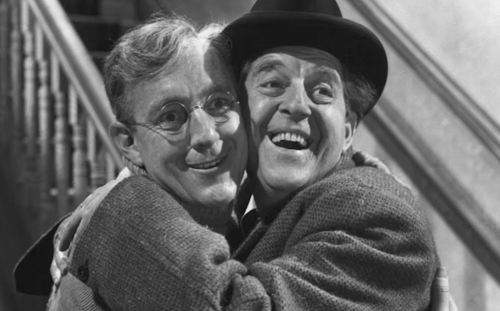
(1948) The seminal all-location Noir. Following a young woman’s murder on W. 83rd St., cops Barry Fitzgerald and Don Taylor track down leads from Stillman’s Gym to the Roxy Theater to the City Morgue to Roosevelt Hospital, with final showdown on the Williamsburg Bridge. Oscar-winning camerawork from former Garbo photographer William Daniels. b&w; Approx. 96 minutes
3:20, 7:00

“A dirt-under-the-fingernails crime flick that would wallop audiences with its newsreel-style cinematography and uncomfortably candid depiction of crime.The film's neo-realist waves not only pushed the Hays Code but washed all the way to France, where in-the-streets photography became the trademark of the Nouvelle Vague. A Weegee crime-scene photograph brought to life... Dassin's films remind us what's eternal about our noirish city.”
– Flavorpill

“Masterfully kinetic!” – Bruce Bennett, The New York Sun

“New York comes to life as it was in its glory years, the era of streetcars,
the Third Avenue El, fedoras, dance halls,
chop-suey joints and a functioning infrastructure.”
– William Grimes, The New York Times

“Perhaps the NYPD urtext. Narrated with full Winchellian snarl by Mark Hellinger, but  the real hero is the camera itself,
which is set free to wander Gotham and enjoy the varied sights it comes upon.”

  – The Village Voice

“An experiment in American neo-realism, filmed almost entirely on the streets of New York with an unfamiliar cast, the film is in outline
a thriller about a police manhunt. But it elaborates this material to highly original effect, creating a vivid portrait of big city life.”

The Guardian

THIEVES’ HIGHWAYTHIEVES’ HIGHWAY

((1949) An asphalt On the Waterfront, as ex- G.I. Richard Conte finds the apple-trucking biz ain’t all applesauce, especially when up against racket kingpin Lee J. Cobb. Screenplay by A.I. Bezzerides. “You will never be able to eat an apple again without calling up visions of trickery, mayhem, vandalism and violent death.” – The New York TImes. b&w; Approx. 94 minutes
1:30, 5:10, 9:00

“There’s tough, and then there’s Thieves’ Highway. Screenwriter A. I. Bezzerides dished up the kind of speeches you could cut your mouth on...
the most doom-laden apple story since Genesis, Chapter Three.”
– Anthony Lane, The New Yorker
Click here to read full article

“Remarkably tough. A descent into an expressionist urban underworld that offers Dassin's fullest vision of injustice. With its hallucinated social realism, Thieves' Highway is an underappreciated classic of 40s grit.”
– J. Hoberman, The New York Times

“Has a confident visual dynamism that harks back to Raoul Walsh’s and William Wellman’s work at Warner Bros. in the ’30s.”
– Bruce Bennett, Moving Image Source

“Brilliantly volatile. A swift, fluid melodrama. Dassin’s best American movie,
it breathes the same air of risk and desperation as his made-in-Europe masterpieces but has a rich sensuality all its own.”
– Michael Sragow
Click here to read entire review

“Slots sleazy eroticism and rigorous action
seamlessly together into a high-grade trucking melo.”
– Geoff Andrew, Time Out (London)

Perhaps the most unjustly neglected of Jules Dassin's preblacklist Hollywood pictures and one of the best noirs ever made by anyone.
A terrific, fast-moving thriller.”
– Jonathan Rosenbaum

“The director's finest film made in America. A bleak portrait of post-WWII despair, corrupt capitalism, and idealistic disillusionment.
Dassin swathes Thieves' Highway's long-haul boys in claustrophobic compositions and menacing darkness, amplifying the sense of danger”

SLANT Magazine

RETURN TO TOP.

MARCH 30 MON (2 FILMS FOR 1 ADMISSION)

REUNION IN FRANCEREUNION IN FRANCE

(1942) Tray Parisian socialite Joan Crawford is irked when Philip Dorn won’t accompany her on a South of France holiday — what’s this about a war anyway? But under the Occupation, while Dorn makes nice with the Nazis, Crawford shelters downed RAF pilot John Wayne (!) — but who really is working for whom? b&w; Approx. 103 minutes
3:30, 7:30

“An enjoyable World War II romance. Lady Crawford suffers in style.”
– Elliott Stein, The Village Voice

“Eyebrows meet swagger as Joan Crawford hides John Wayne in Nazi-occupied Paris.”
– Time Out New York

NAZI AGENT

(1942) In Dassin’s first feature, German-American bookstore owner Conrad Veidt gets a surprise visit from his long-estranged brother, German consul Conrad Veidt (again) with a little espionage offer that Veidt #1 can’t refuse. Plus Dassin’s short debut, The Tell-Tale Heart (“A masterpiece of accelerating tension.” – Gordon Gow). b&w; Total approx. 113 min.
1:30, 5:30, 9:30

“Photographed by Alfred Hitchcock veteran Harry Stradling Sr.,
it was the first of several advantageous director-cinematographer collaborations that would define Dassin’s career.
With its deep-focus compositions and stinger camera moves, Nazi Agent could almost pass for the ’40s work of André De Toth.”
– Bruce Bennett, Moving Image Source

RETURN TO TOP.

MARCH 31 TUE

UP TIGHTUP TIGHT

(1968) In the wake of the King assassination, unemployed Julian Mayfield is too stinko to aid Black militant buddies in a raid on a Cleveland ammo depot, but after his ensuing rejection by the organization, and depressing visit with his hooker-by-necessity girlfriend, that $1000 reward for info starts to look good. Black Power remake of John Ford’s The Informer. Original music by Booker T. and the MGs! Color; Approx. 104 minutes.
1:30, 3:35, 5:40, 7:45, 9:50

“The rarest item in Film Forum's retrospective... ferocious performances; a vivid, almost allegorical use of location; and a sense of bottled rage that explodes in the apocalyptic final half hour. Effectively capped Dassin's career, recapitulating the themes and style of his strongest Hollywood films with a scarcely modulated brute force.”
– J. Hoberman, The New York Times

“Dassin turned his dream of remaking The Informer with an all-black cast into this remarkably tough riot drama.”
– Time Out New York

“An intense and furious movie… the first major American film to deal bluntly with the mind and mood of the black man who has moved beyond the range of the white man's voice. Dassin immediately jumps into the center of a social phenomenon that has been carefully avoided by almost everybody. The effect—on the big movie theater screen—is stunning and hair-raising.”
– Vincent Canby, The New York Times. Click here to read entire review

“It's remarkable that a major studio (Paramount) financed and released this film.” – Roger Ebert

RETURN TO TOP.

APRIL 1/2 WED/THU

HE WHO MUST DIEHE WHO MUST DIE

(1958) In a 1920s Greek village under Turkish rule, it’s time for the traditional Passion Play, with Pierre Vaneck’s stuttering shepherd slated for the Christ role and prostitute Melina Mercouri (in her first film with husband-to-be Dassin) as Mary Magdalene. But when refugees led by Rififi’s Jean Servais flood in, those roles start to become real. Adapted from The Greek Passion by Nikos Kazantzakis (Last Temptation of Christ). Color; Approx. 122 minutes
Wed 2:00, 4:30, 7:00, 9:30
Thu 2:00, 4:30, 9:30

“Has moments of extraordinary power. Mercouri was never less than a force of nature.”
– J. Hoberman, The New York Times

“In the filmic tradition of Rosi, Buñuel, and Scorsese in depicting the dichotomy between the form and spirit of Christianity.”
– Pacific Film Archive

Letter to The New York Times about He Who Must Die

“A brave film and an exciting one, intellectually as well as emotionally.” – Isabel Quigly

“One of the most powerful films of recent years… one that should shock, excite and foment a lot of thinking about humanity.”
– Bosley Crowther, The New York Times

RETURN TO TOP.

APRIL 2 THU (Separate Admission)

BRUTE FORCEBRUTE FORCE

(1947) In a prison so brutal that top guard Hume Cronyn conducts his seemingly routine prisoner beatings shirtless with Wagner on the turntable, rebellious Burt Lancaster is itching to make that big breakout, even as he has to deal with the obligatory psychopath, railroaded honest guy, squealer, etc.; but one of Hollywood’s grimmest climaxes looms ahead. b&w; Approx. 98 minutes
7:30 ONLY

View the trailer: Low | High

“One of the boldest, tautest films of the postwar crime cycle. A sharp evocation of unrest in a totalitarian state.”
– Richard Corliss, TIME

“A darkly entertaining, and surprisingly vicious, cocktail of genre film tropes. Dassin created an atmospheric studio-bound hell.”
– Bruce Bennett, Moving Image Source

“Baroque and electrifying.” – Geoff Andrew, Time Out (London)

“Part antifascist tract, part existential allegory.” – J. Hoberman, The New York Times

"Dassin’s greatest! Here the setting is a prison and the film was made in that golden period when locations, atmospheric black and white photography and a sense of speed and urgency were dominant. The story is tight and the social concern of the piece is genuine and thorough. Very much in line with the Fox films of the period."
- National Film Theatre of London

“One of Dassin's best films. With brutality breeding brutality in this world which the dialogue defines as an existentialist hell
from which there is no escape, Brute Force was a notably violent film in its day.”
– Tom Milne, Time Out (London)

RETURN TO TOP.

APRIL 3/4 FRI/SAT

RIFIFIRIFIFI

(1955) Back from the pen, homme dur Jean Servais rejoins his cronies and freshly imported safecracker “César the Milanese” (Dassin himself, billed as “Perlo Vita”) for a little jewel store smashand- grab job — but Servais wants the whole works! The central heist is an edge-of-your-seat 30-minute sequence sans dialogue or music, so detailed that it provided a usable blueprint for real-life pros. b&w; Approx. 122 minutes
2:00, 4:30, 7:00, 9:30

Click here for more information on Dassin's Rififi

“A vivid exercise that more or less invented the idea of French Film Noir... For the French, Rififi had Hollywood pizzazz; for Americans, it had continental sophistication. For both, it seemed to possess an authoritative naturalism.” 
– J. Hoberman

“The dark pleasures of this jewel-thief thriller are legion, and the influence of this tightly wound film is incalculable. Few crime movies have better captured the taut enthusiasm of planning a heist and the exquisite pain of trying to pull it off.”

 – Time Out New York

“THE BEST FILM NOIR I'VE EVER SEEN. A marvel of skill and inventiveness.” – François Truffaut

“One of the more gripping and captivating crime dramas you'll ever see.”
– The Onion AV Club

“The modern heist movie was invented in Paris in 1954 by Jules Dassin.
Echoes of Dassin can be found from Kubrick's The Killing to Tarantino's Reservoir Dogs. A milestone in movie history!”
– Roger Ebert
Click here to read full review

“For lovers of tough-guy moviemaking, Rififi really means perfection.”
– Michael Sragow, The New York Times

RETURN TO TOP.

APRIL 5 SUN (2 FILMS FOR 1 ADMISSION)

TOPKAPITOPKAPI

(1964) Melina Mercouri and lover Maximilian Schell, backed by a hand-picked team, find their carefully laid plans to heist emeralds from the Topkapi museum in Istanbul laid low by the bumblings of hanger-on Peter Ustinov—in an Oscar-winning performance (Supporting Actor)—then decide to go ahead anyway. Pioneer of the heist genre Dassin (Rififi) keeps his tongue firmly in cheek, but the suspense taut in adaptation from intrigue titan Eric Ambler. The high-tech heist has been appropriated by everything from Mission: Impossible to Wallace & Gromit! Color; Approx. 119 minutes
2:55, 7:00

View the trailer: Low | High


"As playful and lighthearted as Dassin's Rififi is stark and somber,
Topkapi
demonstrates that the director could make a heist picture in any manner he chose."

Time Out New York

“Remains unsurpassed for breathless suspense in its depiction of the jewel heist to end all jewel heists.”
– Terrence McNally, The New York Times

“A hot-rock kaleidoscope.” – Nick Pinkerton, Village Voice

NEVER ON SUNDAYNEVER ON SUNDAY

(1960) In the Athens seaport of Piraeus, hopelessly idealistic and naïve American Homer Thrace (Dassin himself, in a rare co-starring role) — fired up by a little ouzo — gets divested of that darn idealism and Puritanism by Melina Mercouri’s fun-loving hooker Ilya (Cannes Best Actress award and Oscar nomination). Color; Approx. 97 minutes
1:10, 5:10, 9:15

"One of the great liberating films."
– David Shipman

"Charming, it makes great use both of its spectacular location and of Mercouri's irrepressible persona."
Time Out New York

“Remains Mercouri’s quintessential performance. It's not a performance; it's an apotheosis. One of the most popular films of the 1960s. Enormously influential…Its title song was heard around the world. Greece became a magnet for the world's tourists.”
– Terrence McNally, The New York Times

“Dassin expresses his idea in a wonderful rush of animal spirits and earthy humor.”
TIME


RETURN TO TOP.

APRIL 6 MON (2 FILMS FOR 1 ADMISSION)

19:30 PM SUMMER10:30 PM SUMMER

(1966) Melina Mercouri hits the bottle hard when she realizes hubby Peter Finch is dallying with traveling companion Romy Schneider, then decides to help out a local Spaniard on the run, in brooding adaptation of the Marguerite Duras novel. Color; Approx. 85 minutes
1:00, 4:30, 8:00*
*Jean Vallier, biographer of Marguerite Duras, will introduce the 8:00 show.


THE REHEARSAL

(1974) Laurence Olivier, Maximilian Schell, Arthur Miller, Olympia Dukakis, Lillian Hellman, Melina Mercouri and director Dassin rehearse their reenactment of a famous atrocity under the colonels’ regime: the November ’73 massacre of students at Athens Polytechnic. Powerful play-within-a-film agitprop — unreleased for the best of reasons: the Greek junta fell days before its intended opening. b&w; Approx. 92 minutes
2:40, 6:10*, 9:45
*Jackie Raynal, an assistant editor on The Rehearsal (and subject of a current homage at the Alliance Francaise), will introduce the 6:15 show.

“A powerful re-enactment.”World Film Directors

“A powerhouse cast!” – Time Out New York


RETURN TO TOP.

APRIL 7 TUE (2 FILMS FOR 1 ADMISSION)

PHAEDRAPHAEDRA

(1962) Grand, doomed passion among the jet-setters, as shipping tycoon Raf Vallone sends second wife Melina Mercouri (“luminous with fervor and honesty” – The New York Times) to drag alienated son Anthony Perkins back from Parisian exile. Dassin teamed with avant-garde writer Liberaki to update Euripides. b&w; Approx. 115 minutes
1:20, 5:30, 9:50

“Dassin and Mercouri's bold retelling is an important film for both. Here their collaboration is at its most intense and personal. This is a film that looks behind closed doors, and the view is not always pretty. Mercouri risks an on-screen emotional nakedness here that makes physical nudity seem easy.”
– Terrence McNally, The New York Times

A DREAM OF PASSIONA DREAM OF PASSION

(1978) Persona/Medea in Greece, as famous actress Mercouri is berated during rehearsals for Euripides’ play by temperamental director Andreas Voutsinas (“Carmen Ghia” of Mel Brooks’ The Producers!); while a TV camera crew looks on. News of Ellen Burstyn’s murder of her children spurs a speedy prison visit, which turns into mutual therapy sessions as Melina looks for artistic inspiration. Color; Approx. 110 minutes
3:30, 7:40

"Boldly inventive and shockingly convincing...takes chances right and left."
- Gary Arnold


RETURN TO TOP.


Special thanks to Schawn Belston, Caitlin Robertson (20th Century Fox); Ross Klein (MGM); Barry Allen, Melanie Valera (Paramount Pictures); Marilee Womack (Warner Bros.); Eric Di Bernardo, Adrienne Halpern (Rialto Pictures); Issa Clubb (The Criterion Collection); Pauline Tzeiranis (Melina Mercouri Foundation, Athens); Anne Morra, Mary Keene (Museum of Modern Art); Andrew Garroni (Upcoast Film Consultants);
and Ricky Dassin.