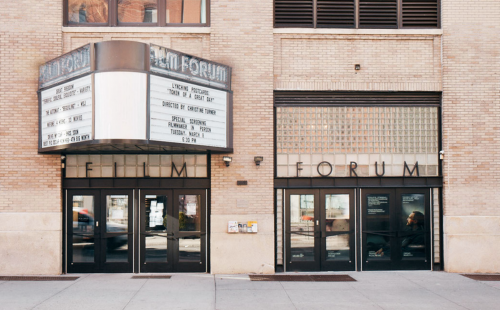










New York’s leading movie house for independent premieres and repertory programming
A nonprofit cinema since 1970
| November 21 - December 2 •
SPECIAL LIMITED ENGAGEMENT! Double feature of Chaplin's masterpieces - (2 FILMS FOR 1 ADMISSION) CITY LIGHTS: 1:00, 4:30, 8:00 • MODERN TIMES: 2:45, 6:15, 9:45 |
|
"A pairing of Chaplin’s perfect blend of comedy and melodrama." | |
![]() CITY LIGHTS |
|
|
(1931) Chaplin on talkies, 1929: “I loathe them.” As stuffy orators intone at the unveiling of a monstrous group
of civic statuary, the speech-less soundtrack imitates kazoos and chickens, even as the Little Tramp is revealed
asleep in the arms of the matronly allegorical statue. And so, for the world of fans who had waited four years
for Chaplin’s response to the talkie revolution, the answer was — except for a recorded music track, with sound
effects like gunshots, clanging bells, and that whistle — a silent movie... and a masterpiece. But this time
channeled through the double tracks of parallel plots: the suicidal zillionaire who, saved from drowning by
Charlie, becomes his bosom buddy... until that darned sobriety returns; and Virginia Cherrill’s beautiful blind
flower girl, who in offering the shabby Tramp a boutonnière, mistakes him for a swell stepping
out from his limo. (Cherrill, a socialite and film neophyte, disliked Chaplin, and vice
versa — he tried to fire her once and cast her only because she could avoid
grotesquerie when faking blindness. Soon after, she became the first Mrs.
Cary Grant.) En route, Charlie mistakes cheese for soap and confetti for
spaghetti, gets stuck streetcleaning behind an elephant, interrupts a
society soloist with whistle-augmented hiccups,continually
unknowingly teeters on the brink as a street elevator up-and-downs
behind his to-and-froing before a naked statue in shop window; | |
![]() MODERN TIMES |
|
|
(1936) Chaplin’s Little Tramp gets
trapped in the coils of automation — at one point literally — so
frenziedly tightening screws on the assembly line that, getting off it,
he compulsively tightens the buttons on a woman’s behind — and
later becoming the guinea pig for an efficiency-promoting feeding machine
gone amok. Obviously inspired by René Clair’s À Nous
la Liberté, not to mention Metropolis, and itself perhaps
an influence on Orwell’s 1984 (note the televised Big Boss-cum-Big
Brother catching Charlie smoking in the men’s room), Modern
Times is a corrosive satire on the dehumanizing effects of technology — the
screeches, groans, and grinds of the machines have more lines than the
actors (the only spoken dialogue, all superfluous, issues from the Boss’s
all-seeing bigscreen tv). But, despite its pre-occupation with the Depression,
poverty and starvation, Modern Times also manages to be (amazingly)
the most lighthearted comedy of the director/star’s later years,
other highlights including the Tramp helpfully waving a red flag dropped
by a departing truck, just as a Communist demonstration marches up behind
him; getting thrown in the slammer, where after accidentally sniffing
a fellow con’s “happy dust” he breaks up a prisoners’ riot;
and that final shuffling walk into the horizon, the last the Tramp would
take — but this time in the company of Paulette Goddard’s
vivacious “Gamin.” Conceived as his farewell to the Tramp,
Charlie remains mum — apart from a song improvised in gibberish
when he loses a cuff with the words scribbled on it — in what is
without question the last great silent movie. Approx 89 mins. AN MK2 PRESENTATION RELEASED BY KINO INTERNATIONAL |
|
|
Available at Amazon.com: |
|
|
|