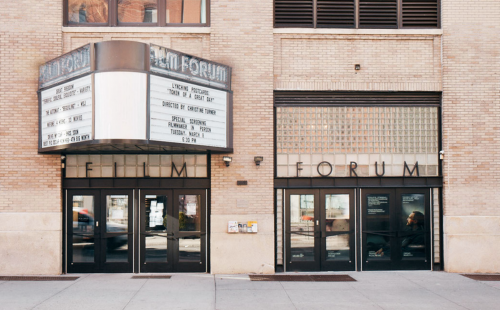










New York’s leading movie house for independent premieres and repertory programming
A nonprofit cinema since 1970
| RETURNING MAY 1 THU 2008 | |
![]() |
|
![]() |
![]() |
![]() |
|
(1931) Chaplin on talkies, 1929: “I loathe them.” As stuffy orators intone at the unveiling of a monstrous group
of civic statuary, the speech-less soundtrack imitates kazoos and chickens, even as the Little Tramp is revealed
asleep in the arms of the matronly allegorical statue. And so, for the world of fans who had waited four years
for Chaplin’s response to the talkie revolution, the answer was — except for a recorded music track, with sound
effects like gunshots, clanging bells, and that whistle — a silent movie... and a masterpiece. But this time
channeled through the double tracks of parallel plots: the suicidal zillionaire who, saved from drowning by
Charlie, becomes his bosom buddy... until that darned sobriety returns; and Virginia Cherrill’s beautiful blind
flower girl, who in offering the shabby Tramp a boutonnière, mistakes him for a swell stepping
out from his limo. (Cherrill, a socialite and film neophyte, disliked Chaplin, and vice
versa — he tried to fire her once and cast her only because she could avoid
grotesquerie when faking blindness. Soon after, she became the first Mrs.
Cary Grant.) En route, Charlie mistakes cheese for soap and confetti for
spaghetti, gets stuck streetcleaning behind an elephant, interrupts a
society soloist with whistle-augmented hiccups,continually
unknowingly teeters on the brink as a street elevator up-and-downs
behind his to-and-froing before a naked statue in shop window; |
|
|
|