





FILM FORUM ONLINE TICKETS | MEMBERSHIP | NOW PLAYING | COMING SOON | TABLE OF CONTENTS
FAQ | ART & MERCHANDISE | FILM SOURCES | SPECIAL EVENTS | SEARCH | LINKS | HOME

VITTORIO DE SICA (Director/Co-Producer/Co-Screenwriter)

(1902-1974)


2002 marks the centennial of Vittorio De Sica, who grew up in Naples in a middle-class, low income environment. While in his teens he contributed to the family resources by working as an office clerk but soon found acting a more satisfying escape from the drudgery of his youth. He made his screen debut in 1918 in The Clemenceau Affair but his acting career did not begin in earnest until 1923 when he joined Tatiana Pavlova's stage company. A handsome man, he was a successful matinee idol by the late 20s and before long formed his own company to produce stage plays, in many of which he co-starred with his first wife Giuditta Rissone. He made a name as a suave leading man in Italian films, mostly light comedies, and became immensely popular with female audiences.


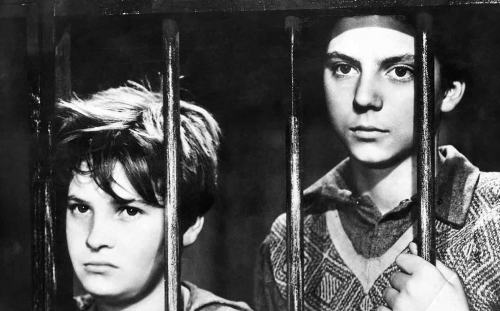
During WW II he became attracted to directing. His first four films as director were routine light productions in the tradition of the Italian cinema of the day. But his fifth, The Children Are Watching Us, marked the beginning of De Sica's collaboration with author and screenwriter Cesare Zavattini, a creative relationship that was to give the world two of the most significant films of postwar Italian neo-realism, Shoeshine (1946) and The Bicycle Thief (1948). In both films De Sica and Zavattini examined the chaotic urban conditions in the aftermath of the war with incisive simplicity and disarming sincerity. In both films social and economic conditions on the streets of Rome were drawn in stark detail as background to a personal emotional drama revolving around a tender human relationship, of two shoeshine boys in Shoeshine, of father and son in The Bicycle Thief. In both films De Sica achieved marvelous results with nonprofessional actors, infusing his characters with his deep humanity and tenderness. The winner of a best foreign film Oscar and other international awards, The Bicycle Thief not only remains a supreme example of neo-realism but is also widely accepted as one of the great films of all time.


De Sica's next film in collaboration with Zavattini was the satirical fantasy Miracle in Milan (1950), which wavered between optimism and despair in its allegorical treatment of the plight of the poor in an industrial society. Umberto D (1952), a film-poem about old age and loneliness, which he dedicated to the memory of his father, was De Sica's last neo-realist film and temporarily his last masterpiece. With the notable exceptions of the popular Gold of Naples (1954), a series of mostly comic sketches set in his native city featuring Sophia Loren, Totò and De Sica himself, and Two Women (1960), a solid work enhanced by the excellent performance of Sophia Loren, his subsequent output as director was for a long while markedly less inspired and significant.


Throughout his career as director, De Sica continued to act in films so that he could finance the kinds of film he wanted to make. He turned almost exclusively to acting in the late 50s and enjoyed great popularity in the role of the affable maresciallo (rural police officer) in Comencini's Bread Love and Dreams (1954) and several sequels in a comedy series co-starring Gina Lollobrigida. He was at his best playing light roles requiring deft irony and flashy charm but proved himself capable of a solid dramatic performance in such films as Rossellini's General della Rovere (1959), Max Ophuls’ The Earrings of Madame De… (1953) and Charles Vidor’s A Farewell to Arms (1957), for which De Sica was nominated for an Academy Award for Best Supporting Actor. In the 60s he was back in the director's chair, turning out such successful box-office ventures as Yesterday Today and Tomorrow and Marriage Italian Style (both 1964), and also quite a few commercial and critical failures, all the while continuing to appear as an actor in films of other directors. And then, when he seemed to have settled on ending his career in mediocrity, De Sica made a dramatic comeback as a director to be reckoned with in 1971 with The Garden of the Finzi-Continis, an exquisite, hauntingly beautiful, and deeply disturbing film about the gradual disintegration of Jewish freedom and dignity in Fascist Italy, a work permeated with humanity and tenderness.    


In all, De Sica directed some 30 films—four of which won Oscars as best foreign films: Shoeshine, The Bicycle Thief, Yesterday Today and Tomorrow, and The Garden of the Finzi-Continis—and appeared as an actor in more than 150 films. He died at 72 following surgery for the removal of a cyst from his lungs. He was survived by his second wife, former Spanish actress Maria Mercader, with whom he had lived since 1942 but whom he could legally marry only in 1968 after adopting French citizenship, which allowed him to divorce his first wife. The eldest son of De Sica and Mercader, Manuel, composed the music for The Garden of the Finzi-Continis; the younger, Christian, is a singer and actor.

Selected Filmography as director

Rose Scarlatte (also act.) 1940

Teresa Venerdi/Doctor Beware (also co-sc., act.) 1941

I Bambini ci Guardano/The Children Are Watching Us (also CO-SC) 1943

Sciuscia/Shoeshine 1946

Ladri di Biciclette The Bicycle Thief/Bicycle Thieves (also prod.) 1948

Miracolo a Milano/Miracle in Milan (also prod., CO-SC) 1950

Umberto D. (also co-prod., CO-SC) 1952

Stazione Termini/lndiscretion of an American Wife (also prod.) 1953

L'Oro DI Napoli/Gold of Naples (also CO-SC, act.) 1954

Il Tetto/The Roof (also prod.) 1956

La Ciociara/Two Women (It./Fr.; also sp-sc.) 1960

Il Giudizio Universale (also act.) 1961

Boccaccio '70 ("The Raffle” episode; It./Fr.) 1962

I Sequestrati DI Altona/The Condemned of Altona (It/Fr.) 1962

Ieri Oggi Domani/Yesterday Today and Tomorrow (It./Fr.) 1963

Matrimonio all 'Italiana/Marriage Italian Style (It./Fr.) 1964

Le Streghe/The Witches (“A Night Like Any Other” episode; It./Fr.)

AFTER THE FOX (1966)

Sept fois Femme/Woman Times Seven (Fr./US) 1967

I Girasoli/Sunflower (It./Fr.) 1969

Il Giardino dei Finzi-Contini/The Garden of the Finzi-Continis (It./Ger.) 1971

Una Breve Vacanza/A Brief Vacation 1973

Il Viaggio/The Voyage 1974


—Adapted from Ephraim Katz, The Film Encyclopedia (Harper Perennial, 1998)


Vittorio De Sica: Director, Actor, Screenwriter by Bert Cardullo

Vittorio De Sica:
Director, Actor, Screenwriter

by Bert Cardullo

RETURN TO TOP


FILM FORUM ONLINE TICKETS | MEMBERSHIP | NOW PLAYING | COMING SOON | TABLE OF CONTENTS
FAQ | ART & MERCHANDISE | FILM SOURCES | SPECIAL EVENTS | SEARCH | LINKS | HOME
Questions/Comments? E-mail Film Forum. Box Office: 212-727-8110. Repertory screen is programmed by Bruce Goldstein. (Schedule subject to change). © 2002, The Moving Image, Inc. All rights reserved. Not to be reproduced without permission. Website Manager: Richard J. Hutchins. This page was last updated on January 28, 2003